
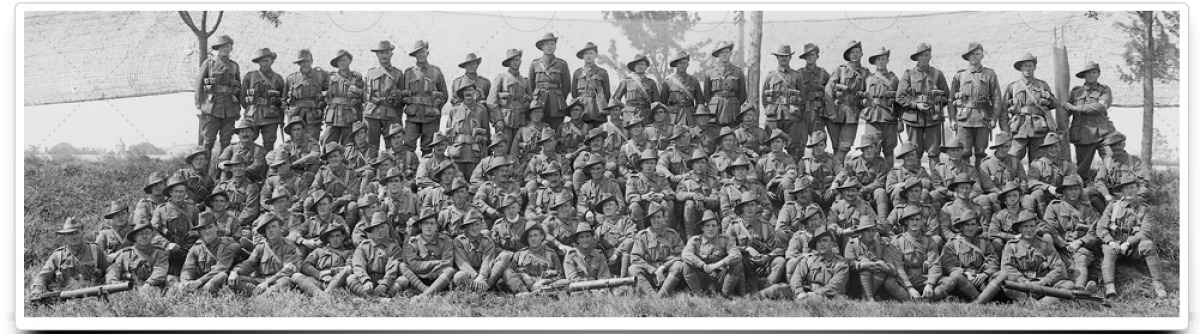
 Orders arrived at 3pm for the 22nd Battalion to be prepared to move forward in readiness to attack the German positions on the high ground to the right of the village of Beaurevoir, between the villages of Estrees and Geneve. The area was filled with enemy dead, the result of an attack earlier in the day by the 5th Brigade. A new zero hour had been set for 6.30pm, but this message did not arrive back with Lieut-Col Wiltshire until just seven minutes before the off, passing the message ‘we attack in seven minutes’ to Lieut.’s Sutherland and Anderson. After a not very intense 18-pounder barrage of six minutes duration the 22nd waves pushed on through the 18th Battalion in isolated outposts just beyond the JOT. Resistance was strongest along the Roman Road along which the 22nd Battalion was attacking. From the men of the 5th Brigade near the road came a warning of ‘mind the quarry’, an excavation on the right of the road held by a strong garrison, all of whom were bayoneted once the position was reached. The attack was made with such verve and initiative that despite a strenuous resistance by enemy
  machine-gunners on the left flank all objectives were quickly secured along with 100 prisoners, thirty machine-guns, four 77mm guns and one 5.9 howitzer. This very decisive victory cost the Battalion only twenty casualties. However amongst the eleven killed were two very well-known and popular officers, Capt. Braithwaite, MC, (photograph above right) and Lieut. Paterson, MC, (photograph below right) commanding officers of ‘C’ and ‘D’ Companies respectively. Capt. Braithwaite along with Lewis gunner Cpl Bonnet were killed in the act of charging the troublesome machine-gun on the left flank. As Capt. Braithwaite fell those nearby heard his last orders ‘Go on C Company’. Lieut.-Col. Wiltshire later wrote, ‘on they charged, mopping up the position and fully avenging their Captain’s death’. Capt. Paterson was killed at a copse on the crest. At 10.30pm instructions came through that the attack was to be continued in the morning in conjunction with the 23rd Battalion on the right and British 7th Brigade on the left. That night the Transport and Quartermasters Staff again did great work delivering rations and stores right up to the men in the front line.
Author: 22ndaif
1st Oct 1918: Aus 3rd & 5th Divs relieved after final victorious fight
Overnight the enemy decided that any further hold on the tunnel line was hopeless and further resistance melted away. By 10am the 5th Division reported the capture of Joncourt and soon passed it over to the 15th Lancashire Fusiliers of the 32nd Division. By midday the whole of the village of Bony was in Australian hands and that patrols were rapidly approaching Le Catelet village, with the Germans withdrawing their troops, transport and guns up the hills beyond the Beaurevoir Line whereupon they settled and began to shell the Australian outposts heavily such they had to be withdrawn beyond the crest. Just to the south the British IX Corps had sized the Beaurevoir Line east of Joncourt. Meanwhile the northern end of the tunnel had been taken and by nightfall the whole operation had been successfully completed. The three day operation had resulted in the capture of 3,057 prisoners and 35 guns. The way was now open for XIII Corps to pass across the line of the tunnel and swing left to knock the enemy out of the northern continuation of the Hindenburg Line, and for the Australian Corps to push on to the final obstacle in the Hindenburg Line, the Beaurevoir Line. The Australian 3rd & 5th Divisions were by now exhausted from their efforts and were relieved by the 50th Division from the British XIII Corps and the Australian 2nd Division respectively. The two relieved divisions now joined the 1st & 4th Divisions in the welcome rest area to the west and south-west of Amiens, their service in the front line now done.
30th Sept 1918: Bulgaria out of the War as Salonika Armistice comes into effect
In Greece the Armistice of Salonika came into effect ending the participation of Bulgaria on the side of the Central Powers in WW1. The terms of the armistice called for the immediate demobilisation of all Bulgarian military activities and the evacuation of occupied Greek and Serbian territories.
29th Sept 1918: Hindenburg Line breached at St. Quentin canal
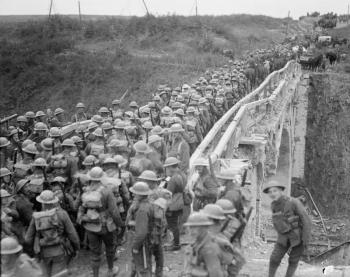 The day broke with familiar mist and at 5.50am the attack on the main Hindenburg Line that lay about the formidable obstacle of the St. Quentin canal was launched. Quite early in the day excellent news came in that the 46th (North Midland) Division within British IX Corps had skillfully crossed the canal at Bellenglise / Riqueval, thereby relieving pressure on the Australian Corps right flank. Pushing on and heading south-eastwards the Australians were surprised to see British troops from the 4th Leicester’s (46th Division) that had managed the extraordinarily difficult crossing of the canal, seizing bridges before they could be blown up (photograph above of the Riqueval bridge). The south entrance to the tunnel was now in Allied hands, but the north still in German. For the Australian Corps Lieut.-Gen. Monash had to amend his plans abandoning the objective of taking the whole Hindenburg Line in one day. Any concern that the enemy might launch a concerted counter-attack against his vulnerable troops astride the canal soon dissipated probably on account of the 46th Division’s success on the right flank.
28th Sept 1918: Allied forces launch Fifth Battle of Ypres
The British Second and the French Sixth Armies supported the twelve Belgian Divisions in the Fifth Battle of Ypres re-taking Passchendaele and Zonnebeke in the process. By the following day Messines was captured and by the 30th September, despite the captured ground becoming another quagmire of mud, all of the high ground around Ypres had been occupied by the Allies. Meanwhile major attacks along the entire front over three days were having its desired effect, and now the British Fourth Army stood poised to break-through the Hindenburg Line at the critical Bellicourt tunnel.
27th Sept 1918: AEF 27th Div fails to take Hindenburg Outpost Line objectives
At 5.30am the 27th American Division fighting within the Australian Corps carried out their attack on the uncaptured Hindenburg Outpost Line under a barrage and aided by tanks. The main objectives were the trench system about Quennemont and Gillemont Farms. The attack by the battle-green Americans failed to take its objectives, and although many men made it to the German trench line they became surrounded until relieved by the Australians two days later. The failure appeared to be down to over eager troops rushing on and not ‘mopping-up’ correctly – a lesson learned the hard way by the British and Australians in 1916 and 1917 – and as a result it compromised the artillery plan for the main assault two days later. Lieut.-Gen. Monash succeeded in getting General Rawlinson to provide additional tanks out of Army reserves to place on the 27th Division front to bring the infantry up to the barrage. Of the five divisions available to Monash, the Australian 2nd Division was to remain in Corps reserve but would be brought forward by motor bus to the vicinity of Peronne.
26th Sept 1918: Americans launch Meuse-Argonne offensive
The Meuse-Argonne Offensive began and lasted for 47 days until the signing of the Armistice on the 11th November and was the largest operation in US military history, involving 1.2 million American soldiers. Commanded by General Pershing it was also the bloodiest operation of the First World War for the American Expeditionary Force who lost over 26,000 men killed. American losses were exacerbated by the inexperience of many of the troops and the tactics used during the early phases of the operation.
21st Sept 1918: AIF largest combat refusal of WW1 by 118 men in 1st Bn
With the Australian 1st Division being withdrawn from the front line following their successful attack three days earlier, orders were received for the 1st Battalion to return to the front to take part in an attack on the Hindenburg Outpost Line and to do what they saw as the ‘unfinished work of III Corps’ on their flank. All but one member of ‘D’ Company refused to take part in an attack as a protest and 118 members of the company that went missing were subsequently Court Martialed and imprisoned for 10 years for desertion. This was the AIF’s largest incidence of ‘combat refusal’ during the war and was a result of the stresses of prolonged periods of combat. All 118 men were pardoned at the end of the war.
18th Sept 1918: AIF 1st & 4th Divs take Hindenburg Outpost Line
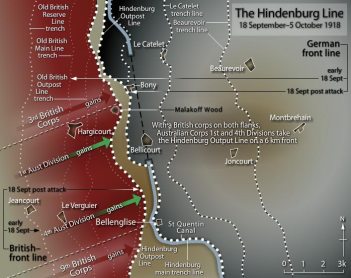 A soaking rain set in two hours before the 5.20am start to attack the Hindenburg Outpost Line (map courtesy of the DVA Anzac Portal), drenching the attackers and defenders alike. The Australian 1st and 4th Divisions attacked with two Brigades and with the exception of Grand Priel Woods in front of the 3rd Brigade no serious opposition was encountered. Under the devastating creeping artillery and machine-gun barrage the first ‘Red Line’ objective across the Corps front was taken by 10am, putting the Australians in possession of the old British front line of March 1918, but still some 1,500 to 2,000 yards from the Hindenburg Outpost Line. Sgt Sexton of the 13th Battalion took out a field gun and several machine guns for which he was awarded the Victoria Cross. Major General Glasgow’s 1st Division pushed on without pause and by nightfall had overwhelmed the garrison of the Hindenburg Outpost Line along its front. Major General Maclagan’s 4th Division also fought its way forward to within 500 yards of that line, but the troops exhausted from crossing difficult terrain and in full view of the enemy, were ordered to rest. Advantage was taken to advance the artillery, and at 11pm the 4th Division again attacked and after severe fighting also captured the whole of the objective trench system, during which Pte Woods of the 48th Battalion rushed a post and held off a counter-attack earning him the Victoria Cross. A great victory had been achieved with relatively little loss. The 1st Division, attacking with 2,854 men suffered 490 casualties in total whereas the 4th Division had 532 casualties from a strength of 3,048. Over 4,200 prisoners were taken in addition to the large numbers of enemy killed or wounded, plus the Corps captured more than 80 guns that had been abandoned by the German Army. As it turned out both the Australian 1st and 4th Divisions had fought their last battle in the Great War, finishing in a blaze of glory.
16th Sept 1918: Monash prepares attack on Hindenburg Outpost Line
Lieut.-Gen. Monash held a conference with his Commanders that would be involved in the next battle, and the date set for the 18th September. After the successful manoeuvre battle at Mont St. Quentin the attack on the Hindenburg Outpost Line would revert back to being a set-piece battle similar to that of the 8th August, though this time there would be just eight tanks supporting the Australians. In order to compensate for the lack of tanks Monash arranged to double the machine gun resources by bringing up complete machine-gun battalions from the 3rd and 5th Divisions, giving a total of 256 Vickers Machine Guns on a frontage of 7,000 yards to deliver a dense machine gun barrage that would advance 300 yards ahead of the infantry. Also to try and trick the enemy Monash ordered the creation of dummy tanks, clearly visible to the enemy, to give the impression that there were many more tanks about to attack, thus hastening the defenders abandoning their positions. On the morning of the attack the moon would set at 3.37am and the sun would rise at 6.27am: zero hour was therefore fixed for 5.20am.
 Following the Twenty-Second