
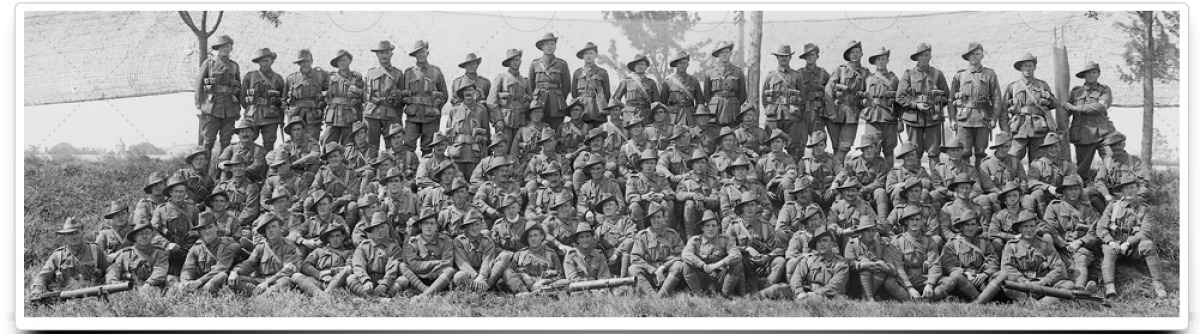
The 22nd Battalion received orders to move to Westhoek to relieve the 20th Battalion in the support line. The relief was carried out that night without incident. There was intermittent shelling throughout the tour in the vicinity of Polygon Wood racecourse.
Author: 22ndaif
31st Oct 1917: Palestine – the Charge of the 4th Light Horse Brigade
After a period of stalemate in Southern Palestine from April to October 1917, on 31st October General Edmund Allenby, who replaced General Murray in June, attacked the Turkish garrison of Beersheba with some 47,500 rifles of the XX Corps and about 15,000 troopers in the Anzac and Australian Mounted Divisions (Desert Mounted Corps). Orders were issued for a general attack on Beersheba by the dismounted 1st and 3rd Light Horse Brigades and the mounted 4th Light Horse Brigade. As the leading squadrons of the 4th Light Horse Regiment of Victorians, and the New South Wales’ 12th Light Horse Regiment came within range of the Ottoman riflemen in defences directly in their track, a number of horses were hit by sustained rapid fire. While the 4th Light Horse Regiment attacking these fortifications dismounted after jumping the trenches, most of the 12th Light Horse Regiment on the left rode through a gap in the defences to gallop into Beersheba to capture the garrison. The Turkish defenders suffered many casualties and between 700 and 1,000 troops were captured, paving the way for the British capture of Gaza.
28th Oct 1917: AFA suffer many casualties in gas attacks
During a night gas attack the 5th & 6th Batteries on Anzac Ridge were put out of action. Between mid–October and mid-November there were over 1,300 casualties in the Australian Field Artillery alone, and although only a small number, 20, were quickly fatal the effects lasted for years to come. The condition of the worst cases was pitiful with eyes swollen and streaming, voices gone and bodies blistered. Whole battalions came out of the line hoarse.
27th Oct 1917: 22nd Bn heads back to Front & into Brigade Reserve
After a restful two weeks at Steenvoorde the 22nd Battalion left billets at 7.30am and marched via Abeele to Dominion Camp in the Ouderdam area. The next day they then marched to a poor camp at Dickebusch where the Battalion formed part of Brigade Reserve to AIF 2nd Division. The strength of the Battalion in the field at the end of the month was 16 Officers and 486 other ranks.
26th Oct 1917: Canadians lead Second Battle of Passchendaele
The Second Battle of Passchendaele began to complete the previous stage and gain a base for the final assault on the village of Passchendaele. The 6th Battalion took part in an attack by the Canadians towards the Keiberg, and despite early success they had to withdraw. The attackers on the southern flank quickly captured Crest Farm and sent patrols beyond the final objective into Passchendaele. The attack on the northern flank again met with exceptional German resistance. The 3rd Canadian Division captured Vapour Farm on the corps boundary, Furst Farm to the west of Meetcheele and the crossroads at Meetcheele but remained short of its objective. In the three subsequent battles in which the Canadians captured Passchendaele the Australian infantry took no part, but supported with artillery and machine gun fire.
24th Oct 1917: Massive defeat for Italian Army at Caporetto
Austro-Hungarian forces reinforced by German units attacked the Italians in what became the Battle of Caporetto. The attacking forces, employing the use of stormtrooper tactics and poison gas routed the Italian Army in what was one the greatest defeats in Italian military history. The reinforcing response resulted in the sending of six British divisions to bolster the Italians, and together with the weather in northern Europe on the Western Front effectively ended the 3rd Ypres offensive. Furthermore the removal of the British divisions together with the shortage of reinforcements meant that any plans Field Marshall Haig had for a resumption of the Ypres offensive in the Spring 1918 were now receding.
22nd Oct 1917: Canadians begin relief of Anzacs at Passchendaele
The AIF 3rd Division in the II Anzac Corps Line was relieved by the Canadian 4th Division, with the Canadian 3rd Division relieving the New Zealand Division the following day.
16th Oct 1917: Germans drench Anzacs with mustard gas
For four nights between the 14th & 19th October the Germans drenched the valleys behind the Australian lines with mustard gas, causing 116 casualties in I Anzac Corps area on the 16th alone. The 43rd Battalion in II Anzac Corps had to evacuate 40 men blistered and gassed after work on the railway near Zonnebeke.
12th Oct 1917: 22nd Bn arrives at Steenvoorde for two weeks recovery & refitting
The 22nd Battalion left camp at 7am and entrained at Ypres Station for Abeele and marched to Steenvoorde to the billets previously occupied where they remained for the next two weeks. The Companies were now organised as three platoons per company on account of the weak strength of the Battalion, with only about 75 men per company available for the next tour of the front line. Necessary refitting began, with training of the Lewis Gunners, Signallers, Scouts and Observers receiving priority, but also with sports events and concerts. Here Lieut. Miles received his Captaincy, and commissions were granted to CSM Dundas, and Sergeants Bourke, Hutton, Howell and Barker. The list of decorations for work at Ypres was also published [see Medals & Awards].
12th Oct 1917: First Battle of Passchendaele – NZ’s black day
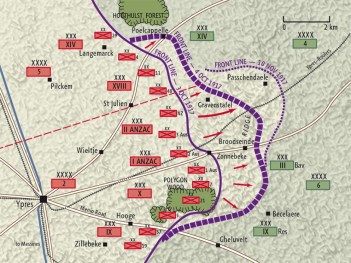 The First Battle of Passchendaele was the last Australian attack during the Third Battle of Ypres and attempted to capture the village of Passchendaele. The AIF 3rd Division and the New Zealand Division of II Anzac Corps, with the AIF 4th Division on the flank, advanced alongside five British divisions, but were bogged down in the valley well short of their objective. For the New Zealanders this attack and day was the most costly during the entire war with 2,700 casualties. The Germans retained control of the high ground on Passchendaele Ridge opposite the I and II Anzac corps, where the attack was repulsed or troops were forced by counter-attacks to retire from most captured ground. The battle had been a German defensive success but was costly for both sides.
 Following the Twenty-Second