
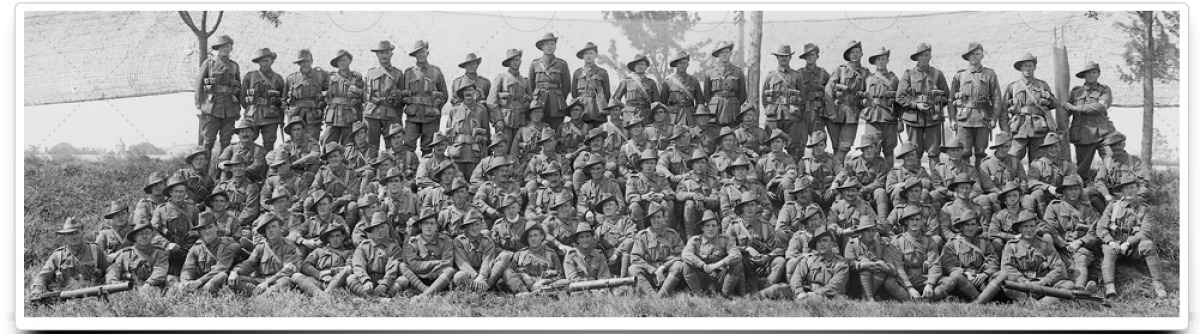
The 22nd Battalion left camp at noon and route march for Camp No.2 at Kortepyp close to Ploegsteert via Drancoutre and the nearby Neuve Eglise. They arrived in camp at 2.30pm, with no men falling out. The new camp consisting of huts was in fair repair. The 41st Battalion took over the camp at Kemmel with the 22nd relieving the 42nd Battalion. On arrival at Kortepyp Camp the Battalion became part of the 6th Brigade in Reserve to the 5th & 7th Brigades in the front line from the River Douve to a point near Armentieres. The 6th Brigade was ordered to be prepared to move forward at short notice in case a counter-attack is launched. The officer’s Christmas dinner was held at Kortepyp Camp. Here the Battalion remained for a month, training or working on reserve lines in the morning, with sports in the afternoon.
Author: 22ndaif
15th Dec 1917: Armistice between Russia and Germany
Following the revolution and the collapse of their army, Russia agreed the Armistice with Germany, thereby enabling the German commanders to move hundreds of thousands of men with their, guns and equipment to the Western Front.
11th Dec 1917: Gen Allenby enters Jerusalem after Turkish surrender
Two days after the official surrender by the Turks and exactly six weeks after the fall of Beersheba, General Allenby, commander of the EEF, made his formal entry into Jerusalem. Among the mounted units to accompany Allenby into Jerusalem were the 10th Light Horse Regiment and and a representative of the New Zealand Mounted Rifles Brigade. At this time the 12th Light Horse Regiment was in the Judean Hills on the front line near Kuddis, where the disposition of the Ottoman defenders was static and quiet.
8th Dec 1917: Aus PM telegraphs London re: concerns over Trotsky’s peace proposal
In light of the recent Russian proposal for peace talks across all fronts, the Australian Prime Minister telegraphed to the Secretary of State for the Colonies: “I am seriously disturbed by the position on the Italian, Russian and Western Fronts and desire to know the views and intentions of the War Cabinet re Trotsky’s peace proposals and prospects on the Western Front and generally. I earnestly hope that His Majesty’s Government will not waver in its resolution to press on at all costs. Though recognising the appalling difficulties…. I am profoundly convinced that to recede one inch from the position taken up and set out by Lloyd George would be absolutely disastrous. Please communicate this telegram to members of the War Cabinet.” Six days later Lloyd George insisted that there could be no true peace for the Allies without reparation.
28th Nov 1917: Allies reject Armistice talks offer
On the day that the Russians were discussing the Armistice on the Eastern Front, Trotsky as Bolshevik Commissioner for Foreign Affairs, issued an invitation to the Allies to take part. The Allies declined.
20th Nov 1917: First large-scale use of tanks in Battle of Cambrai
 The Battle of Cambrai saw the first large-scale use of tanks in WW1 combined with artillery and infantry working in tandem. Punching through the heavily barbed wired German defences the success of the tanks on the first day was then followed by failure with the unreliability of the tanks plus strong German artillery and infantry defence. Within three days the Germans realised that the Allied breakthrough had failed and they themselves looked to deliver a decisive counter-attack using their newly formed stormtrooper tactics. By the end of the fighting on the 7th December neither side had gained any significant territorial advantage and at comparable losses of about 45,000 men on both sides. Cambrai however saw both sides put into action strategies that would lead to greater successes in the coming year.
14th Nov 1917: I Anzac Corps goes into winter positions at Messines
The British Army in Flanders went into its winter positions and for I Anzac Corps, relieved from their front line positions, they proceeded to the quiet front at Messines. The Ypres fighting from September to November 1917 had cost the Australians 38,093 officers and men, and with the dwindling stream of reinforcements from Australia, anxieties were growing whether they would be able to reinforce sufficiently. For General Birdwood the focus was now turning to the winter and how to keep the troops well and avoid the illnesses and trench foot that had caused many casualties the previous winter on the Somme. Sports and entertainment were given high priority.
11th Nov 1917: 22nd Bn relieved and marched to Wippenhoek camp
Heavy rain fell and flooded all the shelters before the 22nd Battalion was relieved by the 8th Battalion West Yorks of the British 49th Division. One night was spent at Dickebusch before marching the following day to Wippenhoek. During the day the enemy shelling was more active than usual, causing one killed, 1224 Cpl Blondett, and two wounded.
10th Nov 1917: Canadians take Passchendaele, and so ends the 3rd Ypres offensive
The Canadian 1st and 2nd Divisions mounted the final and successful attack to take Passchendaele. The final attack was carried out in a rainstorm. The weather, combined with a reinforcing response to the joint Austrian-German attack in Italy at Caporetto that necessitated the sending of six British divisions to bolster the Italians, resulted in the end for the 3rd Ypres offensive. Furthermore the removal of the British Divisions together with the shortage of reinforcements meant that any plans Haig had for a resumption of the offensive in the Spring 1918 were now receding.
7th Nov 1917: October Revolution hastens Russia’s exit from WW1
Capitalising on the February revolution which overthrew the Tsarist autocracy in Russia, an armed insurrection led by the Bolsheviks and Vladimir Lenin took place on 25th October 1917 (7th November 1917 in the New Style) in Petrograd, leading to the world’s first self-proclaimed socialist state. The October Revolution hastened Russia’s exit from WW1, leading to the Treaty of Brest-Litovsk signed on 3rd March 1918 between the new Bolshevik government of Soviet Russia and the Central Powers (Germany, Austria-Hungary, Bulgaria, and the Ottoman Empire).
 Following the Twenty-Second