
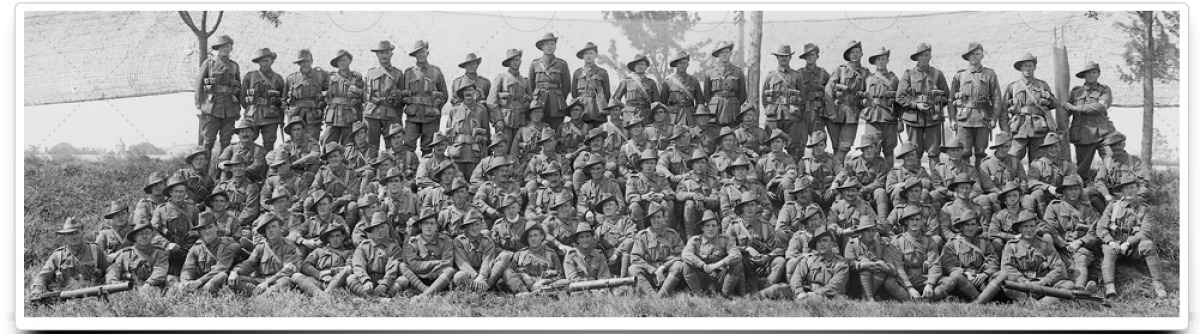
 At 10pm on the 24th April 1918 the British artillery opened on the village of Villers-Bretonneux as the two brigades of the AIF, the 15th Brigade to the north and the 13th Brigade to the south, prepared to counter-attack and to encircle and then regain the village. Within five minutes the German barrage started to fall on the assembly positions and at 10.10pm with all battalions in position the attack commenced. For the 51st Battalion of the 13th Brigade they had to pass a wood on their left which had supposedly been cleared by the British earlier in the day but flares were soon in the air and German machine-guns enfilading their advance. Pressing on to their objective at Monument Wood would have been futile at this stage so the local decision was taken by Lieut. Sadlier (photograph below) to attack the wood and bomb the guns out. His attack for which he was awarded the Victoria Cross was extraordinarily bold taking the German machine-gunners by surprise and with the Western Australians fighting wildly in the dark and amongst the
  trees. By this audacious attack all the machine guns along the edge of the wood were eventually silenced and a great danger was removed from the flank of the advancing brigade. To the centre and right better progress was made, but in one incident they ran into a party from the 2nd Devon and 1st Worcester who unaware of the counter-attack thought that they were being attacked by Germans from the rear. As the 13th Brigade advanced they had to now negotiate the diagonally running wire entanglements that had been erected to stop the Germans, who by now had positioned their outposts on the other side of the wire. By morning the wire was lined by the dead of the 52nd and 51st Battalions. Some 500 yards beyond lay a stronger line of defenders but once having engaged with their Lewis guns the Australian line rushed yelling and shouting and the Germans, newly arrived from the eastern front and not used to this ferocity, turned and ran as the 52nd chased the fleeing parties into the dark between the Monument and Hangard Woods The 51st on the left, whose progress had been hindered earlier by the fire from the woods plus the railway embankment that ran to the south of the village, reached a quarry in which several British wounded who had lain there since the previous morning were found, along with a German tank lying on its side. However the objective at Monument Wood was becoming less achievable as the attack moved forward with the Germans to the left and rear in the village, and the 7th Bedford’s on the right not in contact with a flanking company so a decision was made to establish a defensive line on the high ground behind the quarry. Although short by between a quarter and a mile from their objective, they had still pushed forward a mile and in a position to squeeze out the Germans in the village if the 15th Brigade to the north were able reach its objective.
Author: 22ndaif
24th Apr 1918: First tank duel as Germans take Villers-Bretonneux
At 4.45am and under a mist an intense German artillery bombardment including gas shells fell on Villers-Bretonneux extending six miles south of Hangard into the French sector. This was not a resumption of the Michael offensive but a localised attack to put pressure on Amiens and create a diversion to the offensive that was taking place in Flanders. The village and its front was held by the 8th British Division, a particularly good British division but which had lost half of its 10,000 infantry in the March offensive. Reinforcements now coming from England included many young fresh-faced soldiers, and in some cases the battalions were more than half manned by boys under the age of nineteen. To the north and rear of the town Brig-Gen. Elliott’s 15th Brigade were in divisional reserve, with the 14th Brigade manning the front to the north of the village. If the village was lost Elliott had already primed his 59th & 60th Battalions for the counter-attack. Around 8am patrols from the two 15th Brigade battalions came across both wounded and non-wounded British troops that the Germans had been attacking with tanks. By 8.35am the 14th Brigade’s 56th Battalion in reserve on Hill 104 could see the village and that the Germans were now holding it and advancing north i.e. around the front of the 14th Brigade, but the position was secured through both the 56th Battalion and a battery of British field artillery firing at point blank range. At about noon the 8th Division began their counter-attacks, the first of which was delivered by three heavy tanks, one ‘male’ and two ‘female’. Heading for the vulnerable Cachy Switch Trench the tanks soon came  across at a distance of 300 yards a German tank approaching with two waves of infantry, and two more tanks on either side. The machine-gun carrying ‘female’ tanks were no match and after being fired upon retired leaving tank commander Lieut. Mitchell in his ‘male’ tank, carrying two six-pounder guns, to fight what would become the first tank duel with the leading German tank, manoeuvring to bring first one gun into action and then the other. Eventually Mitchell took the risk of stopping to give the gunner a better platform and at once hit the opposing tank three times causing the crew to abandon and flee (photograph above of the disabled German tank ‘Mephisto’). Seeing this and to his surprise the two other tanks turned and made off. As Mitchell retired after being hit by artillery shell he was passed by seven light ‘Whippet’ tanks speedily coming in to action to clear up the situation in front of Cachy, causing havoc to the German battalions forming up in the open. German artillery and their remaining tanks fired at the whippets putting four out of action, but by now the contemplated attack by the Germans had been foiled. As for the British, the only counter-attack carried out with success by the infantry was by 2nd Royal Berkshire in front of the 14th Brigade’s position on Hill 104. At 9.30am and as soon as General Rawlinson had learnt of the loss of Villers-Bretonneux he ordered the nearest Australian reserve brigade, the 13th Brigade billeted at Querrieu north of the Somme, to march south at once to III Corps to assist in the recapture of Villers-Bretonneux, which as he put it was ‘imperative to the security of Amiens’.
21st Apr 1918: The ‘Red Baron’ killed & given full military burial by No.3 Sq. AFC
 In the skies above the Somme there was much activity with Manfred von Richthofen, the ‘Red Baron’ and his red squadron again involved. While chasing a British scout over the Australian sector von Richthofen was himself dived by Canadian airman Captain Roy Brown who thought he saw the Red Baron collapse under his fire. Brown broke off but noticed the scout and von Richtohfen fly on for about a mile, flying low along the valley and now a target for the many Lewis gunners and riflemen on the ground. As the two planes rose to clear the hill to the east of Corbie, von Richthofen swerved and crashed. There is still debate whether it was Capt. Brown or an Australian gunner that was responsible for von Richthofen being killed. Regarded in high respect by the Allied air officers von Richthofen was given a full military burial with officers from No.3 Squadron Australian Flying Corps acting as pallbearers and the guard of honour from other ranks of the squadron firing a salute (photograph above). Von Richthofen was originally buried in the cemetery in the village of Bertangles before being moved to the German Military Cemetery at Fricourt in 1920, and five years later was he brought back to Germany by his family.
17th Apr 1918: 1st Bgde inflict huge losses on attacking Germans
The Australian sector at Strazeele was shelled heavily, and though the German guns had yet to be accurately registered the village and the railway station were wrecked. At 10am the Germans attempted to attack up the valley between Merris and Meteren but were met with a deluge of fire from the 4th and 1st Battalions. The 1st Brigade estimated that they had caused between 1,500 – 2,000 casualties whereas the 3rd Battalion to their south estimated that at the railway embankment their Lewis and machine-gunners had accounted for 700 casualties. By contrast the casualties in the AIF 1st Division were few.
However strain was being felt on the entire British front, with seven divisions needing withdrawal and rest after four weeks of the offensive, and being severely understrength were vulnerable if the German attack was continued. To assist in this situation General Foch agreed to send French divisions north to bolster the defence. To the south the German artillery drenched the village of Villers-Bretonneux with 12,000 gas shells, repeating the exercise the following day causing the defending battalions to lose a considerable amount of their men. A captured German confirmed that this gas bombardment was as a prelude to a coming attack on the village.
15th Apr 1918: Skillful German sniper targets 22nd Bn Sergeants
A skillful German sniper opposite the Battalion’s right caused many casualties during this tour in the front line opposite Dernancourt. He specifically devoted his talent against the 22nd Battalion’s Sergeants, six of whom were made casualty including Sgt Aspinall and Sgt Corry who were killed in action, before he himself was dealt with. While out on patrol Lieut. Armstrong was wounded and 2nd Lieut. Sutherland was wounded a few days later.
14th Apr 1918: British line stabilised in front of Hazebrouck
The first attack on the AIF 1st Division’s new front line at Hazebrouck was made shortly after midnight when a Company of Germans came marching up. Holding their fire until they were within twenty yards they were met with withering fire and the attacking survivors panicked and fled. At daylight more Germans were seen massing and marching forward for an attack. The seven brigades of the Royal Field Artillery covering the Australians effectively scattered the attackers, and the Lewis gunners and machine-gunners had rich targets albeit at long ranges of a half mile and more. The waves that got closer were met by rifle fire from the forward posts. With the exception of two posts of the 8th Battalion which were destroyed nowhere else did the Germans reach the Australian posts. Along with the 5th British Division, the Australians had completely stabilised the front between Hazebrouck and St.Venant, and furthermore the British First Army to the south had thrust back the Germans. For the Germans attacking from Merris, the battle of the 14th April was their third day in which they had come against a stubborn defence and the stress was beginning to take its toll, and with this set-back the offensive was suspended to the south and west of Armentieres.
Meanwhile on the Somme the 22nd Battalion returned to the front line at Dernancourt, relieving the 21st Battalion
13th Apr 1918: 1st Div take up positions around Strazeele
At daylight battalions of the AIF 1st Division began to take over forward positions around Strazeele, having passed refugees with laden carts on the roads heading west, then entering into empty villages and abandoned houses. Six miles of the army’s emergency front line was being held by the 7th, 8th, 3rd & 4th Battalions from south to north, with their outposts behind hedges, in back-gardens, or orchards of farmhouses and cottages. Farmhouses became prime targets for the artillery of both sides, being reduced to ashes by incendiary shells within a matter of days. At dusk it was evident that most of the troops previously ahead of the Australians would have withdrawn to their rear before the next morning.
10th Apr 1918: 22nd Bn relieved and returned to Support Line
The Battalion was relieved by the 21st Battalion and returned to the Support Line surrounding Lavieville. Thus began a period of rotation with its sister battalion from the 6th Brigade until the end of the month. The expected attack never came, but tension was high and the strain severe. During this time much digging and wiring was done.
9th Apr 1918: Germans launch Operation Georgette in Flanders
 As the 3rd & 2nd Brigades of the AIF 1st Division were marching to relieve the AIF 3rd Division in the Baizieux and Corbie areas of the Somme, a disturbing message was received at its headquarters that the Germans had attacked the previously quiet sector of the front held by the Portuguese troops between the La Basse canal and Bois Grenier and had penetrated four miles on a ten mile front. They later heard that the front had been extended north of Armentieres which the I Anzac Corps had just left. At 7.30pm came a message countermanding all moves previously laid down for the division and warning it to be prepared to entrain next day for the north. Unbeknown to the Australians at this stage, the Germans had on 9th April 1918 launched their next phase in the Kaiserschlacht – Operation Georgette , or the Battle of the Lys – with with the thrust towards the vital British rail-head at Hazebrouck and gateway to the Channel ports of Calais, Boulogne and Dunkirk. The belts of wire entanglements and concrete strong-points built so diligently by the Australians during the previous winter were overrun in just a few hours.
9th Apr 1918: 22nd Bn signallers strive to keep comms established
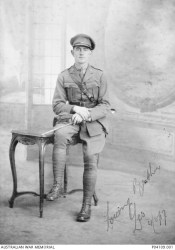 A feature of this Lavieville sector was the constant artillery strafing of Pioneer Trench and the Albert-Amiens Road. The bombardments used to come in short violent bursts and it would soon sever all signal wires running to the forward positions. It was in re-establishing communications that Lieut. McCartin (photograph right) was wounded, and his excellent work recognised by the award of a Military Cross.
 Following the Twenty-Second