
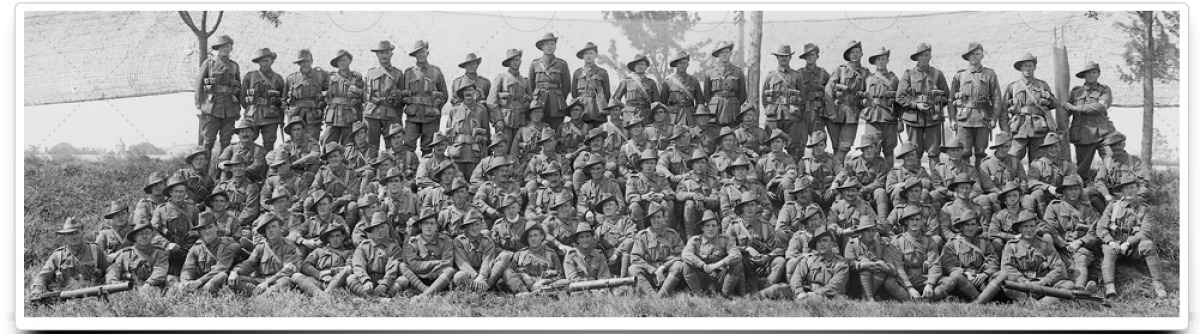
The Australian 3rd Division came into the line on the north, with each of three divisions now operating a single brigade frontage – 11th Brigade (3rd Division), 8th Brigade (5th Division) and the 97th Brigade (British 32nd Division). To each division a squadron of Australian Light Horse and Cyclist Battalions were assigned to provide energetic forward reconnaissance through vigorous pursuit and to keep pressure on the enemy rear-guards and disrupting any plans they had to replicate the ‘scorched earth’ policy that they had employed during the 1917 withdrawal to the Hindenburg Line.
Category: Uncategorized
4th Sept 1918: Somme obstacle for Australians vigorous pursuit of retreating enemy
 From the morning of the 4th September it was obvious that the German Army intentions were to withdraw to the Hindenburg Line some 20 kms distant to the east. The Somme that had been to focal point for so many years had been crossed and now attention was turning to the enemy’s last line of defence. However on the Australian Corps the river still caused a great obstacle and for many days in early September the area was a mass of activity in fixing, strengthening or rebuilding bridges and crossing points to enable all the machinery of war to move eastwards. Every available technical unit that could be spared from other urgent duty was concentrated upon this vital work. Most of the Engineer Field Companies, three of the five Pioneer Companies, both Tunnelling Companies and all the Army Troop Companies laboured in relays night and day. Peronne itself was now becoming a bottleneck, at times resembling central London at peak traffic time. Learning from way that the retreating German Army had devastated the area during the 1917 withdrawal to the Hindenburg Line, the French and British Commanders ordered their forward units to follow a vigorous pursuit policy.
3rd Sept 1918: Rawlinson praises Australian 2nd Div for Mont St. Quentin success
 By the night of the 3rd September Lieut.-General Monash’s Australian Corps had achieved all its objectives set since the launch of the offensive four days previously, and resulted in the award of eight Victoria Crosses (click on link or photographs to read more), the most in any single Australian action during the Great War. During the offensive the Australians had suffered some 3,000 casualties but had taken 2,600 prisoners. General Rawlinson referred to the operation as the finest single feat of the war, with many of the congratulations falling to Major General Rosenthal’s 2nd Division (photograph above right of the Australian 2nd Division monument, Mont St. Quentin). “The capture of Mont. St. Quentin by the Second Division is a feat of arms worthy of the highest praise. The natural strength of the position is immense and the tactical value of it, in reference to Peronne and the whole of the system of the Somme defences, cannot be over-estimated. I am filled with admiration at the gallantry and surpassing daring of the Second Division in winning this important fortress, I congratulate them all with my heart.” Rawlinson.
2nd Sept 1918: Sgt Batton & RSM Cadwell both receive third gallantry award
Eight men from the 22nd Battalion were awarded for their gallantry during the support to the Australian 2nd Division attack at Mont St. Quentin. Included within this group were Sgt Batton of the 5th Reinforcements who received a Distinguished Conduct Medal to add to his Military Medal and Bar, and RSM Cadwell a Military Medal to his Distinguished Conduct Medal and Belgian Croix de Guerre making them, along with Lieut-Col. Wiltshire, the most decorated men in the 22nd Battalion during the Great War.
1st Sept 1918: 6th Bgde captures Mont St. Quentin
 The 6th Brigade, some 1,334 strong, had been ordered to cross the Somme and move up behind the 5th Brigade in readiness to carry the attack and take possession of the remainder of the main Mont St. Quentin spur. Passing over the line won the previous day the 21st, 23rd and 24th Battalions assault in the rain carried it well over the crest of Mont St. Quentin. Pte Mactier (photograph top right) of the 23rd Battalion was killed while silencing machine guns that blocked the way for which he was posthumously awarded the Victoria Cross. Sgt Lowerson of the 21st Battalion (photograph bottom right) led a charge that overcame the centre of resistance on the left flank, and Lieut. Towner of the 7th Machine Gun Company
 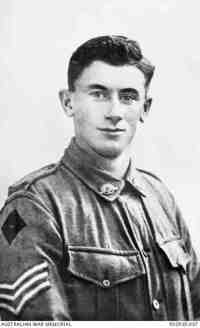 provided continuous covering fire for which both men were awarded the Victoria Cross. Ferocious hand to hand fighting took place, with the bayonet to the fore and as a result very few enemy prisoners were taken that day. After two attempts the summit of the Mont was taken and with it a commanding position over Peronne and the land to the east. The 7th Brigade moved forward into support thereby relieving the 5th Brigade from front line duty. Meanwhile just to their south on the Australian 5th Division front the 14th Brigade had crossed the river at Clery (see map below) besides the 6th Brigade and the 53rd and 54th Battalions assaulted with a direct attack against Peronne. Many belts of wire had to be struggled through before crossing the moat and taking the western half of Peronne. Cpls Hall, Buckley (posthumously) and Pte Currey were all awarded the Victoria Cross. During the day the Brig-Gen. Elliott’s 15th Brigade made spirited attempts to cross the river and to co-operate from the south but suffered a number of casualties in the process.
31st Aug 1918: Yelling 5th Bgde launches 2nd Div Mont St. Quentin attack
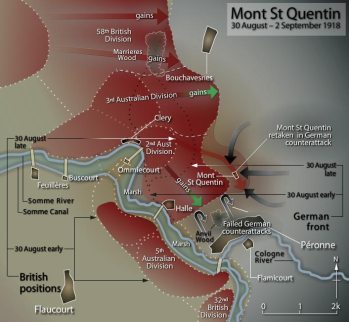 The advance by three battalions of the 5th Brigade of the Australian 2nd Division began at 5am on the 31st August 1918. With an average of just 330 men each the 19th, 17th and 20th Battalions attacked yelling and making as much noise as possible to make it appear that their numbers where much greater than they actually were. The ruse worked resulting in the surrender of many of the enemy lying out in their advanced positions, and a nest of seven machine guns was rushed and taken without any loss. The centre (17th) and left (20th) Battalions gained a footing in Feuillaucourt and on the main hill but the progress of the 19th Battalion on the right was stopped by heavy machine gun fire from St. Denis. This was the site of a ruined sugar refinery and lay on the main road between Peronne and Mont St. Quentin, and the defenders held out to the last. The 17th Battalion had by 7am passed through the ruins of Mont St. Quentin village and had crossed the main road when it received a strong counter-attack while it was recovering from the initial assault causing it to withdraw across the road to an old trench system to the west. The 19th Battalion beat off five successive counter attacks inflicting severe losses upon the enemy though suffering themselves 380 casualties. [Map courtesy of Australians on the Western Front]
29th Aug 1918: Australian Corps reach the Somme overlooking Peronne
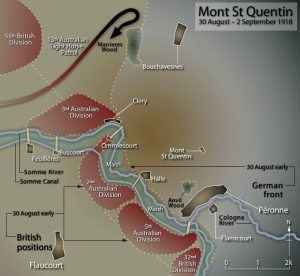 The line of the Somme had been reached and all three divisions south of the Somme stood upon the high ground sloping down to the river looking past Peronne and as far south as St. Christ (map courtesy of Australians on the Western Front). To the north of the river the 3rd Division kept in step reaching Suzanne, Vaux, Curlu, Hem and Clery. The last two days of the advance led the Australian Corps across the maze of trenches and debris of the 1916 campaign. The weather was unfavourable, there was little shelter plus the Germans fought a determined withdrawal all leading to the line brigades reaching the Somme in a very tired condition. Later that day Lieut.-Gen. Monash called a conference with his Divisional commanders at Proyart to discuss the next phase, the crossing of the Somme and the taking of Mont St. Quentin.
27th Aug 1918: 22nd Bn fighting patrols push the line forward
The relief of the 10th & 11th Battalions in the front line was completed at 2am and immediately fighting patrols from the 22nd Battalion went ahead, engaging the enemy wherever found with bomb and bayonet. By dawn the firing line had been advanced by 1,500 yards, during which Cpl Moodie was awarded the DCM, but at the cost to the Battalion of some twenty casualties of whom five were killed in hand to hand fighting in the dark. Amongst those killed was Lieut. Wall, MC, who was held in high esteem by the men. The advance was continued until noon with the 24th Battalion passing through Dompierre and with the 22nd Battalion mopping up. The Battalion Lewis gunners intercepted an attempt to withdraw two German field guns, with the guns captured. The constant advancing was fatiguing, as sleep was a luxury and the strain on the nerves was constant not knowing what lay immediately ahead.
26th Aug 1918: Allied offensive widened with Second Battle of Arras
The Allied offensive was further widened by the British First and Third Armies attacking over a 7 mile front in what became the Second Battle of Arras. Having been just released from the British Fourth Army on the Somme where they along with the Australians spearheaded the great offensive of 8th August, Lieut.-Gen Currie’s Canadian Corps found itself now in the same role for General Horne’s First Army at Arras. In the first blow of the new Arras offensive the Canadians took Monchy-le-Preux with slight loss while British troops pushed out on the flanks. The Canadians would go on to break the Drocourt – Queant Line on 2nd September.
23rd Aug 1918: Australian Corps success in Battle of Chuignes
 The 4.45am dawn attack by the Australian 1st Division and the British 32nd Division supported by a creeping barrage, full artillery engagement plus Tanks and Aircraft in what became known as the Battle of Chuignes was an unqualified success. Characterised by a series of river valleys feeding into the Somme, it was an ideal country for machine gun defence from the numerous woods, hedges and copses in the area. The 32nd Division successfully captured Herleville and the 1st Division under the skilful leadership of Major-General Glasgow had seized ground to a depth of 2,400 yards from Herleville to the western edge of Cappy by the river. The Germans suffered many casualties at the hands of the onrushing infantry supported by the Tanks which disposed of the numerous machine gun units, plus 3,100 prisoners were taken along with 21 guns plus a huge 15 inch railway gun that had been bombarding Amiens. To the north of the river the 3rd Division took the village of Bray, with the 40th Battalion taking 200 prisoners with few losses. This defeat in the Chuignes Valley compelled the German High Command to abandon all hope of holding the ground to the west of the Somme and they began the evacuation in the coming days ahead. In the British Third Army sector V Corps were now only two miles outside of Bapaume, and Field Marshal Haig issued a new order to be less cautious and for each division to be given a distant objective for exploitation.
 Following the Twenty-Second