
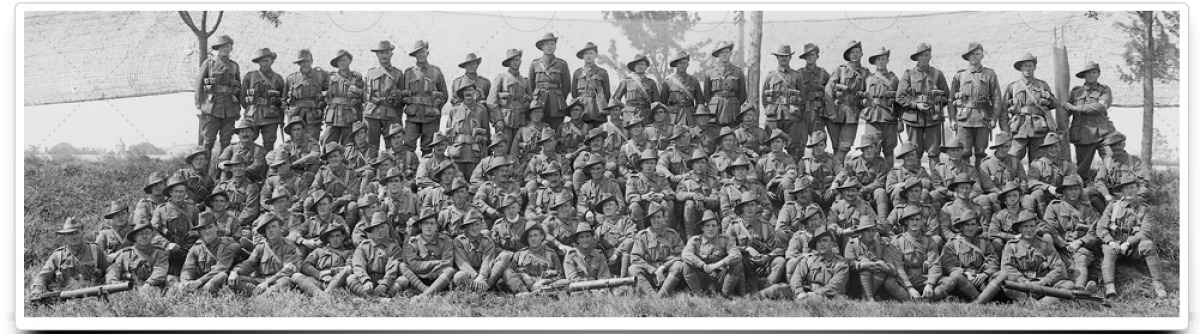
The 22nd Battalion moved into the front line, with the 19th Battalion on the right flank and 24th Battalion on left, at La Basse Ville facing the town of Warneton, in an area with a very bad reputation owing to the number and size of ‘minnies’ employed by the Germans. The line was held by a system of posts, ‘B’ & ‘D’ Companies in the firing line, ‘A’ in support and ‘C’ in reserve. The ground was frozen hard, and snow a few inches deep lay on the ground.
Category: 22nd AIF
12th Jan 1918: 22nd Bn move forward to the Catacombs dug-out ‘city’
The 22nd Battalion moved to Romarin and then via Light Railway to a system of dug-outs called the Catacombs just behind Ploegsteert Wood. These catacombs were an underground dug-out city, large enough to comfortably house a couple of 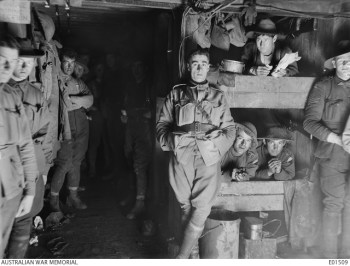 thousand men, consisting of great timbered drives and tunnels into the side of Hill 63. In galleries driven at right-angles off the main passages, long rows of wooden bunks were erected. The place was electrically lighted and though the atmosphere was a little stuffy, troops fresh from the line were very appreciative of the solid comfort of a good dry bed. [Photograph of the 6th Brigade in the Catacombs].
26th Dec 1917: 22nd Bn work on Corps Line of defence at Ploegsteert
On Boxing Day the men from the 22nd Battalion continued with fatigues and the main work at the time, namely the construction of the second or Corps Defence Line, with 90 men loading and unloading stores at Romarin siding. This building of defences was in response to Field Marshall Haig’s orders that predicted that the Germans would go on the offensive in early 1918, deploying the thousands of  men and equipment now released from the Eastern Front following the Armistice with Russia, and before the Americans arrived in strength and tip the balance in favour of the Allied forces. For the men of the 22nd Battalion and 6th Brigade this meant utilising the strong natural features afforded at Hill 63 and the natural obstacle of Ploegsteert Wood, a task conducted under the supervision of Major JS Dooley, MC. [AWM photo E04488 showing men from the 22nd Battalion working on the construction behind Ploegsteert Wood]
15th Dec 1917: 22nd Bn move forward & into Brigade Reserve near Ploegsteert
The 22nd Battalion left camp at noon and route march for Camp No.2 at Kortepyp close to Ploegsteert via Drancoutre and the nearby Neuve Eglise. They arrived in camp at 2.30pm, with no men falling out. The new camp consisting of huts was in fair repair. The 41st Battalion took over the camp at Kemmel with the 22nd relieving the 42nd Battalion. On arrival at Kortepyp Camp the Battalion became part of the 6th Brigade in Reserve to the 5th & 7th Brigades in the front line from the River Douve to a point near Armentieres. The 6th Brigade was ordered to be prepared to move forward at short notice in case a counter-attack is launched. The officer’s Christmas dinner was held at Kortepyp Camp. Here the Battalion remained for a month, training or working on reserve lines in the morning, with sports in the afternoon.
11th Nov 1917: 22nd Bn relieved and marched to Wippenhoek camp
Heavy rain fell and flooded all the shelters before the 22nd Battalion was relieved by the 8th Battalion West Yorks of the British 49th Division. One night was spent at Dickebusch before marching the following day to Wippenhoek. During the day the enemy shelling was more active than usual, causing one killed, 1224 Cpl Blondett, and two wounded.
7th Nov 1917: 22nd Bn relieves 20th Bn in Support Line
The 22nd Battalion received orders to move to Westhoek to relieve the 20th Battalion in the support line. The relief was carried out that night without incident. There was intermittent shelling throughout the tour in the vicinity of Polygon Wood racecourse.
27th Oct 1917: 22nd Bn heads back to Front & into Brigade Reserve
After a restful two weeks at Steenvoorde the 22nd Battalion left billets at 7.30am and marched via Abeele to Dominion Camp in the Ouderdam area. The next day they then marched to a poor camp at Dickebusch where the Battalion formed part of Brigade Reserve to AIF 2nd Division. The strength of the Battalion in the field at the end of the month was 16 Officers and 486 other ranks.
12th Oct 1917: 22nd Bn arrives at Steenvoorde for two weeks recovery & refitting
The 22nd Battalion left camp at 7am and entrained at Ypres Station for Abeele and marched to Steenvoorde to the billets previously occupied where they remained for the next two weeks. The Companies were now organised as three platoons per company on account of the weak strength of the Battalion, with only about 75 men per company available for the next tour of the front line. Necessary refitting began, with training of the Lewis Gunners, Signallers, Scouts and Observers receiving priority, but also with sports events and concerts. Here Lieut. Miles received his Captaincy, and commissions were granted to CSM Dundas, and Sergeants Bourke, Hutton, Howell and Barker. The list of decorations for work at Ypres was also published [see Medals & Awards].
10th Oct 1917: 22nd Bn relieved from front line
The 49th Battalion relieved the 22nd at 4am in the forward posts on the firing line and moved back to the old Red Line, now the Support Line. At 7pm the worn out remnants of the Battalion made their way slowly back to the dug-outs on the Ypres-Comines canal near Ypres.
9th Oct 1917: Under-strength 22nd Bn attacks on flank in Battle of Poelcappelle
The French First Army and British Second and Fifth armies attacked in the Battle of Poelcappelle on 9th October 1917, on a 13,500 yards front, from the Broodseinde ridge towards Passchendaele. The AIF 2nd Division would provide the 5th & 6th Brigades for the right flank of the attack. The 5th Brigade made its second objective, but with the failure of the untried British 66th Division within General Godley’s II Anzac Corps on their left, were alone and with numbers too small to eject the Germans who remained between the posts, they themselves were beaten back to the first objective suffering heavy losses. On the right the 6th Brigade attacked with all four under-strength battalions – 23rd, 21st, 24th and 22nd Battalions from north to south – on a frontage of 1,200 yards but with an average strength of just 7 officers and 150 other ranks, and at least half of the men fresh from the nucleus at Caestre. So thin was the barrage that from the start the German machine guns were able to cause havoc for the advancing parties. During the attack the AIF 2nd Division suffered 1,253 casualties. General Birdwood later wrote that the return of heavy rain and mud sloughs was the main cause of the failure to hold captured ground. German General Kuhl concluded that the fighting strained German fighting power to the limit but that the German forces managed to prevent a breakthrough, although it was becoming much harder for them to replace losses.
 Following the Twenty-Second