
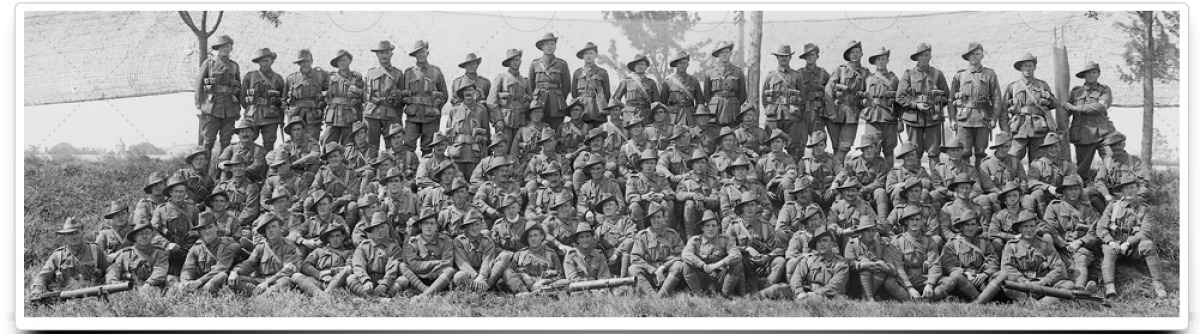
Expecting that the withdrawal of the German Divisions was in preparation for a major offensive in Flanders, any British Divisions that could be spared from the front-line should be withdrawn, and the AIF 1st Division was duly withdrawn and their frontage taken over by the AIF 2nd and 5th Divisions.
Author: 22ndaif
28th Feb 1917: AIF 1st Div take three villages
By the morning of the 28th the villages of Thilloy, Ligny-Thilloy and Le Barque were within the AIF 1st Division’s line, which now lay in comparatively green country and a distance of some 500 – 800 yards from the German main position, Till Trench. On the right the 15th Brigade of the AIF 5th Division had cleared the enemy from Barley Trench to the German pivot point at Le Transloy. To the west the 7th Brigade made seven attacks to Malt Trench but all were bombed back with heavy loss on both sides. British Fifth Army commanding officer General Gough visited the area and seeing the importance of Malt Trench gave the order for the bombardment of the German wire to begin at once.

27th Feb 1917: AIF 3rd Div successful first major raid
Preceded by a program of smaller raids through January and February, the AIF 3rd Division conducted its first major raid at Houplines on the French/Belgium border outside of Armentieres. Carried out by a composite battalion of the 10th Brigade of 20 Officers and 804 other ranks, the large successful raid was preceded by a bombardment which included gas and smoke shells, a tactic that AIF 3rd Division Commanding Officer General Monash would use to great effect later in the war when commanding the AIF.
26th Feb 1917: 22nd Bn relieved and returns to Shelter Wood Camp
The 22nd Battalion was relieved by the 24th under the cover of fog. By noon the remnants of the Battalion had concentrated back at Shelter Wood Camp where it remained until the rest of the month, resting and receiving the next draft of reinforcements. During this last tour of front line duty the battalion had suffered some sixty casualties.
25th Feb 1917: Nine 22nd Bn killed attacking Malt Trench; Sgt Harwood awarded French Croix de Guerre
Many enemy could be seen in the vicinity of Malt Trench outside of Warlencourt and with resistance being encountered on the left of the I Anzac Corps front held by the 2nd Division, Gellibrand, in temporary command of the Division, decided on a determined advance and to take Malt Trench which was the enemy’s most important defence on this part of the front. The 18th Battalion of the 5th Brigade was met with fire from several machine guns and casualties were heavy. Snipers were active including against the stretcher-bearers and wounded. The 6th Brigade was quickly summoned to attack with little preparation and attacked with two companies each of the 21st and 22nd Battalions. The two companies of the 22nd Battalion were led by Lieut. Bazeley (C Company) and Captain Cull (D Company) who had earlier audaciously reconnoitred the position during the day, noting that the German wire had not been cut. He was informed however that there would be no artillery support to cut the wire and that the attack must proceed at all costs at once. Scouts were sent out to discover passages through the wire. As C and D Companies reached the top of the hill outside of Warlencourt some fifty yards from the entanglements, Germans in their trench opened fire with machine-guns and rifles. Cull ordered his men to lie in shell-holes and wait for reports from the scouts, but when no report came, he gave the order to charge. His impetus carried him over the first stake but he got entangled in the second where his hip was shattered by a bomb. Lieutenant Corne and Private Martin tried to extricate him, but Corne was hit and killed. Twenty of the men found an opening in the entanglement and under the leadership of Sgt Harwood entered an unoccupied portion of Malt Trench but were shortly afterwards driven out by machine gun fire. Captain Cull and  several of his men were captured and made prisoner of war. At dawn in Little Wood a patrol from C Company was engaged and a stray bullet detonated a box of bombs being brought forward causing 16 casualties killed and wounded, including L-Cpl Kruger, DCM. Several were also wounded by booby traps left by the enemy. In all 50% of the men engaged in the failed attack of the 25th/26th February became casualties, including nine men from the 22nd Battalion killed. During this action four men from the battalion were awarded for their gallantry including the wounded 2151 Sgt Harwood who was awarded the French Croix de Guerre (picture right), and 2346 temporary Sgt McCormack of the 5th/22nd the Military Medal.
24th Feb 1917: Probing following reports of German withdrawal
Following reports from British V Corps that the Germans had abandoned their forward trenches, I Anzac Corps along with British II Corps were ordered that night to probe into enemy forward positions. From their discoveries and prisoners taken it became apparent that the Germans had made a massive change in their strategic plans and what was being observed was the voluntary abandonment by the Germans of their great salient between Arras and the Aisne.
23rd Feb 1917: The great German withdrawal begins
The German Army evacuates Serre, Miraumont, Petit Miraumont, Pys and (facing the I Anzac Corps) Warlencourt near Bapaume, falling back 25 miles to establish stronger positions along the Hindenburg Line. The shorter defensive position behind the Noyon Salient was built to economise on manpower, contain an Allied breakthrough and make possible a deliberate withdrawal to prepared positions utilising strong-points and protected by 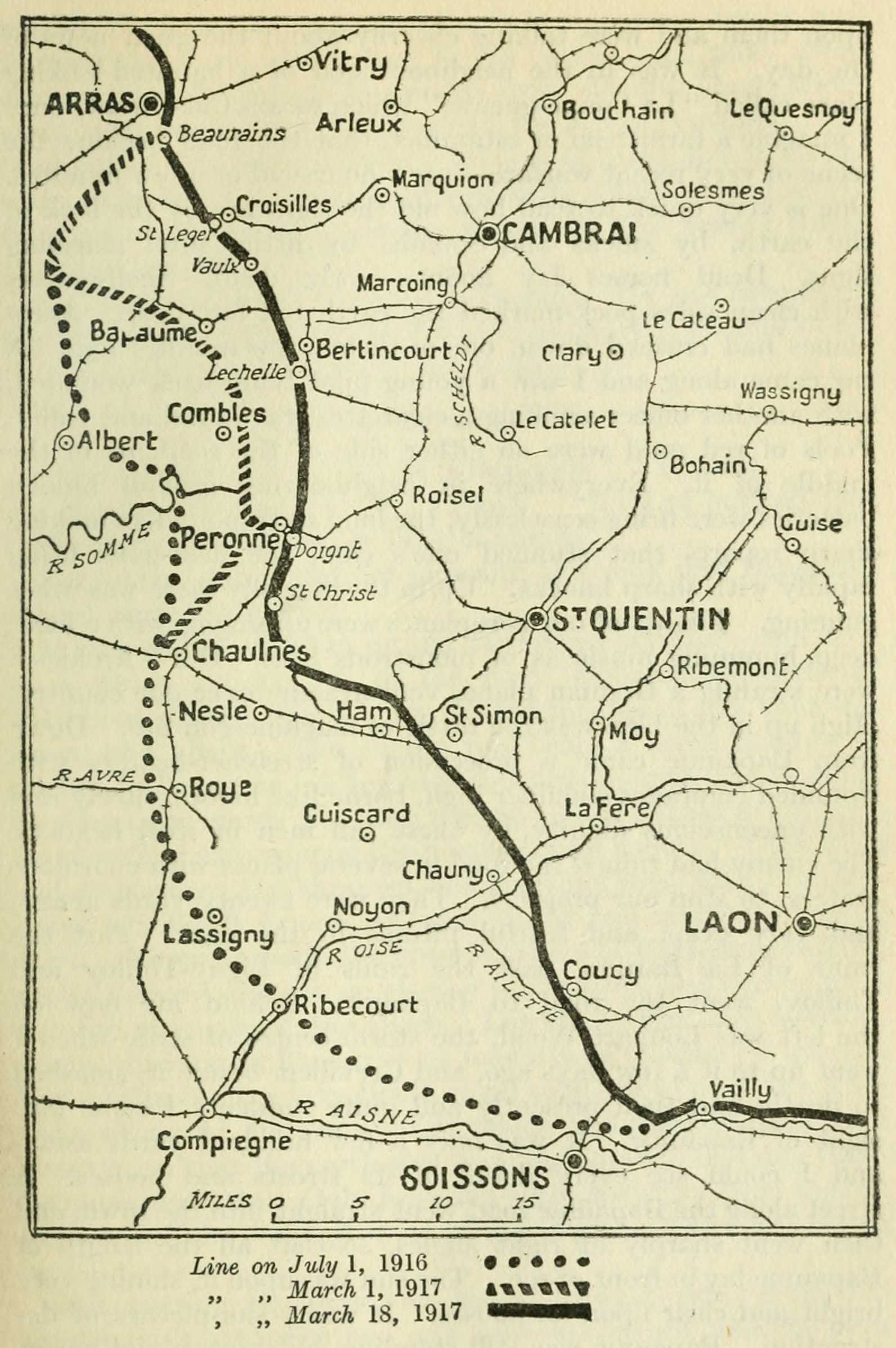 thick wire entanglements. By destroying the infrastructure and demolishing civilian buildings in the salient before a withdrawal, the Germans could dislocate Franco-British offensive preparations, by forcing them to advance into a wasteland. The British and French armies would need about eight weeks to rebuild roads, bridges and railways in the abandoned area before they could attack. A shorter Western Front could be held with fewer troops and by incorporating the lessons of defensive battle on the Somme, the importance of troop dispersal, reverse-slope positions, defence in depth and camouflage, German infantry casualties could be reduced. While the German army recuperated from the losses of 1916, protected by the Hindenburg Line and similar defensive positions on the rest of the Western Front, a return to unrestricted submarine warfare and a strategic bombing offensive against Britain were planned.
21st Feb 1917: German wireless messages intercepted re: imminent movement
Wireless messages intercepted by the British Fifth Army from the rear of the three German divisions facing it ‘to dismantle and be prepared to move with all material, and not to leave anything behind’.
21st Feb 1917: 22nd Bn returns to the Firing Line
The 22nd Battalion marched out to relieve the 23rd Battalion in the Firing Line, and despite the deep mud that impeded the progress, the relief was completed by 3.15am. Except for scattered shelling the night was quiet. The first patrols found No-Man’s land quiet but just after dawn Cpl Wittner lost direction and was killed by a bomb thrown from a German post that he had stumbled across.
16th Feb 1917: Thaw commences and a return to the mud
In the third week of February the thaw commenced. Within days the communication trenches had returned to a quagmire hindering the supply of bombs to the front for further attacks.As the month was dragging to an end the snow melted, and the forward area was a semi-frozen sea where movement was difficult, and every shell-hole a trap for the stumbler. At Shelter Wood the 22nd Battalion had baths and spent time cleaning up, but mud and slush was everywhere. In the evening concerts and card parties were held.
 Following the Twenty-Second