11th Apr 1917: First Bullecourt – poorly planned attack a disaster for the gallant AIF 4th Div.

The First Battle of Bullecourt – click on link below to Combat Areas > AIF Divisions > Bullecourt for a more detailed account.

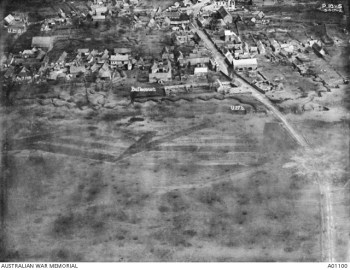
Troops of the AIF 4th Division assaulted the Hindenburg Line at Bullecourt in what was a poorly planned and executed attack. Instead of relying on the customary artillery barrage to destroy the thick belts of barbed wire, British commander General Hubert Gough decided to employ 12 tanks to advance ahead of the infantry in order to retain the element of surprise. On 10th April almost all of the tanks failed to arrive at the rendezvous point. The attack was delayed until following day, giving the Germans full warning of an imminent assault. The 4th and 12th Brigades set off to attack the Hindenburg Line with little support from the tanks. The infantry covered over 1,000 yards of no-man’s land without artillery support, in full view of German machine-gun crews, but still managed to negotiate thick belts of barbed wire and gain partial possession of the Hindenburg Line. The Australians quickly expended all their ammunition while holding the line against German counter-attacks. Ordered to withdraw, they negotiated a no-man’s land swept with German artillery and machine-gun fire. The battle cost the 4th Division over 3,000 casualties, of which 1,170 were taken prisoner – the largest capture of Australian troops on the Western Front.

10th Apr 1917: Hospital Ship HMHS ‘Salta’ sunk with loss of 130 lives.

HMHS_Salta.jpg

While returning to pick up wounded at the port of Le Havre, France, HMHS Salta struck a mine at 11:43, one mile (1.6 km) north of the entrance to the dam. A huge explosion smashed the hull near the stern in the engine room and hold number three. Water rushed into the disabled ship which listed to starboard and sank in less than 10 minutes. Of the 205 passengers and crew members, nine nurses, 42 member of the Royal Army Medical Corps (RAMC) and 79 crew drowned. The British patrol boat HMS P-26 attempted to come alongside to assist, but also struck a mine and sank.

10th Apr 1917: 12th & 4th Bgdes on ‘JOT’ for Bullecourt attack when told ‘stunt is off’.

British Royal Engineers fire gas cylinders over Bullecourt in preparation for the attack. By 4.15am the attacking battalions of the 12th and 4th Brigades were in position to their tapes and assembly positions, but there was no sign of the tanks. Lying out in the snow, the two Brigades would be easily seen between Bullecourt and Queant once dawn arrived. At 5am the message arrived that the ‘stunt is off’, those lying on the tapes simply rose and walked back without formation like a crowd from a football match. But communication between the AIF 4th Division and the British 62nd Division was lacking, and the British pushed on with their attack but without support were forced to retire suffering some 162 casualties.

Later that day Field Marshall Haig’s Chief of Staff calls General Gough informing that the Third Army was going to resume the attack in the morning to the north and to press home their gains, and that the Fifth Army must support the effort, against Birdwood and White’s serious concerns, not least a heavy reliance upon the tanks and the tiredness of the troops.

9th Apr 1917: The Great Arras Offensive begins – a historic day for Canada at Vimy Ridge.

VimyAt dawn the British First and Third Armies launched their great offensive at Vimy and Arras respectively. It had been prepared by a massive artillery bombardment greater than that at the Somme, and the infantry advanced more effectively under a creeping barrage. The attack succeeded in most of the areas and at Arras success was almost complete, taking the first two defensive systems. For the Canadians at Vimy Ridge this was the first time their four divisions fought together as a unified force and despite heavy losses this victorious day would be seen as key in their evolution from dominion to an independent nation.

9th Apr 1917: I Anzac Corps receives praise as last of Hindenburg Line outpost villages taken.

The main attack on the village of Boursies began at 4.45am and took place on the same day as the start of the Arras offensive, this action acting as a minor feint to the main battle taking place further north. The 10th and the 12th Battalions took the village at a cost of 341 casualties. The attack by the AIF 1st Division also included a successful attack on the village of Hermies by the 1st Brigade. Except for a few of the garrison, practically all of the Germans were either killed or taken prisoner, but at a loss of 253 officers and men for the 2nd and 3rd Battalions, of which a high proportion of 1 in 3 were killed. The 1st Battalion moved on Demicourt and occupied the village, sustaining 55 casualties.

By successive local advances made at night without serious opposition, the I Anzac line was over the next few nights pushed forward to within less than a mile of the Hindenburg defences. General Gough telegraphed his congratulations to the AIF 1st Division adding ‘Throughout the advance since the end of February the enterprise, tactical skill, and gallantry of the whole Anzac Corps has been remarkable and is deserving of the highest commendation.’

6th Apr 1917: US declares war on Germany.

US war declaration.jpgOn 2nd April 1917, President Woodrow Wilson went before a joint session of Congress to request a declaration of war against Germany. Wilson cited Germany’s violation of its pledge to suspend unrestricted submarine warfare in the North Atlantic and the Mediterranean, as well as its attempts to entice Mexico into an alliance against the United States, as his reasons for declaring war. On April 4, 1917, the U.S. Senate voted in support of the measure to declare war on Germany. The House concurred two days later.

Although 14,000 US infantry landed in France on 26th June 1917 to begin training, it would take at least 12 months before US troops were present on the Western Front in enough numbers to have any effect on the outcome of the war.

4th Apr 1917: Reduced artillery begins bombardment of Hindenburg Line.

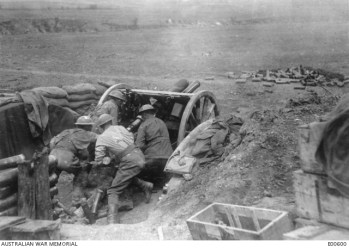
Artillery Bullecourt - E00600A limited number of batteries began their bombardment of the Hindenburg Line, their reduced number caused by delays in being able to bring the artillery forward and the limited obscured places available for them in this sector on account of the geography of the valleys running perpendicular to the front line. Furthermore, the supply of ammunition for the artillery was also limited by the difficulty of transporting it forward, though the Germans were surprised how much the British were able to bring in to their forward position given the destruction they had caused to the infrastructure during their withdrawal.

2nd Apr 1917: AIF 4th Div takes Noreuil, last of the outpost villages in front of Bullecourt.

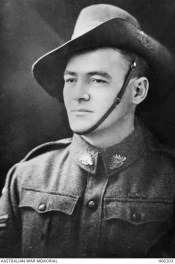
jensen-h06203At 5.15am the supporting barrage started to fall on the enemy positions and the two battalions of the 13th Brigade advanced together. The 51st Battalion met with machine-gun fire from the left, right and the sunken Noreuil-Longatte road ahead, causing eighty men to fall, before the position was taken and prisoners captured. The 50th Battalion were having difficulties as the suppressing barrage was too thin to be effective, and suffering enfilade fire from pockets of Germans behind the steep bank in the sunken lanes. During the fighting Pte Jensen (photograph right) rushed a position and bluffed more than forty Germans to surrender, and was awarded the Victoria Cross. With the Lewis gunners firing from the hip, the battalion advanced. However by 8.45 the position was becoming precarious. The Germans were holding the gullies in strength and the Australian casualties were mounting as the Germans started to attack with bombing parties. Fighting continued all day, but by dawn when the 51st were preparing to rush the German positions, they had found that they had retired during the night.

NoreuilThus on the left half of the Fifth Army’s front the last obstacle to Gough’s projected diversion against the Hindenburg Line had been removed, and all divisions began pushing their posts closer to the main defences which scarred the open country a mile or so ahead of them.
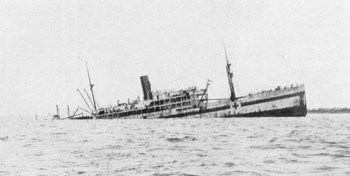
31st Mar 1917: HS Gloucester Castle torpedoed with loss of 3 lives

gloucestercastleThe Gloucester Castle was a steam ship requisitioned by the British for use as a hospital ship during the First World War, operating in the Mediterranean between Lemnos and Malta and taking the wounded back across the English Channel from the Western Front. On one such voyage from Le Havre to Southampton on 31st March 1917 when carrying 399 patients including 300 cot cases, she was torpedoed by German U-boat U-32 off the Isle of Wight. All the patients were evacuated by the attendant destroyers and other transports, but three unfortunately died during the transfer. Although badly damaged she was eventually towed into port.