
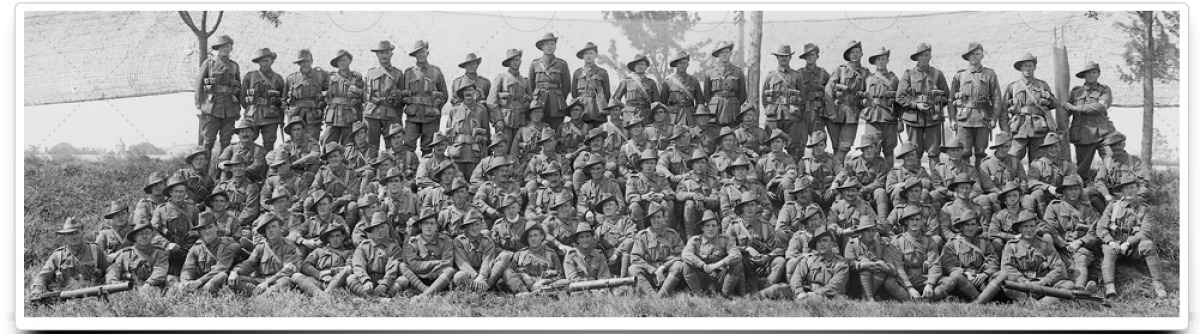
Two practice barrages took place in preparation for the following day’s attack – the first at 6.30am by the whole artillery of the army lasting an hour, and at 8.30am by the guns of I Anzac Corps for 18 minutes. The German artillery was also active and at 5.30am the SOS signal went up and two hours later it was clear that the Germans had attacked and seized part of the front line, the forward ammunition dump for the next day’s attack had been blown up, and that preparations including the creation of the JOT for the attack would be visible to the enemy. 15th Brigade Commanding Officer General Elliott decided to send two companies of the 60th Battalion forward to restore the breached line and shore up his flank, but against a deteriorating system with the Germans shelling and aeroplanes shooting at his troops. Columns of Germans were seen moving forward against the 58th Battalion and by 10am had worked their way round their flank to fire at them from behind. The Middlesex’s supported by the Argyll & Sutherlands pushed forward on the 15th Brigade flank and the German thrust ended, but for Elliott he had thrown in all but the 59th Battalion of his infantry for the following days attack, and the 58th and 60th had suffered heavy losses. At 7pm Elliott called General Hobbs (AIF 5th Division Commanding Officer) to inform the seriousness of the situation however Hobbs and Birdwood confirmed that the attack would take place and that the 8th Brigade would lend two battalions.
Author: 22ndaif
23rd Sept 1917: 22nd Bn relieved & into Corps Reserve ahead of next attack
During the night the relieving battalions of the AIF 1st & 2nd Divisions – including the 22nd Battalion – were themselves relieved by the AIF 4th & 5th Divisions in preparation for the next blow. So ended with complete success the first phase in Field Marshal Haig’s step-by-step tactics, with the British Army achieving its objectives and even more cleanly than at Messines in June. British and German losses were comparable, between 20,000 to 25,000 men on both sides, of which Australian casualties within the AIF 1st & 2nd Divisions numbered 5,013. However the German troops came out of this battle crushed, and the British comparatively fresh, leading to an air of optimism both in the field, in France and back in England.
21st Sept 1917: 22nd Bn move to Support Line under heavy shelling
The Battalion left their bivouacs at 5pm and headed back to the front to relieve the attacking battalions from the successful Menin Road attack. The 6th Brigade took over the newly captured ground on the Becelaere Ridge from the 5th & 7th Brigades, and during the night the Battalion relieved two battalions of the 7th Brigade near Hannebeke Wood in what was now the support line, in an area littered with German dead. Enemy shelling was heavy and continuous and the Battalion suffered close to 100 casualties, including fourteen killed or died of wounds. ‘A’ Company alone lost almost forty men during this tour of duty. Lieut. Thwaites was seriously wounded and as a consequence invalided home to Australia.
20th Sept 1917: The Battle of the Menin Road
At 5.40am British artillery and machine-guns opened up signalling the start of the attack. The Australian 1st & 2nd Divisions, together with four British on their right and five on their left on an eight mile front moved forward. This was the first time in the War that two Australian divisions had attacked side by side, and this gave a boost to the men knowing who was on their flank.  The Battle of the Menin Road (map courtesy of Australians on the Western Front 1914-1918) went to plan. The artillery barrage was the densest that had covered the Australian troops so far, and it was the artillery that did the damage. In many cases the Germans in the heavily protected pill-boxes offered little resistance. By 6.09am the first objective was reached along the whole of the British offensive. Between 7.30 and 7.45am the second objective had been reached on the Australian front and most of the British front in accordance with the timetable. At 9.53am the long pause ended and the barrage came down in front of the Blue Line. The advance to the third objective, the Green Line, was short lived with prisoners taken and pillboxes captured. Shortly before noon German troops and artillery were seen moving in preparation for a counter-attack, but almost immediately were drenched with shells. Nightfall was marked by another German movement met once again by a ferocious artillery barrage, and with this ended the fighting on the Anzac front. British and German losses were comparable, between 20,000 to 25,000 men on both sides, of which Australian casualties within the AIF 1st & 2nd Divisions numbered 5,013. However the German troops came out of this battle crushed, and the British comparatively fresh, leading to an air of optimism both in the field and in England and France.
18th Sept 1917: 22nd Bn relieved from Menin Rd front-line
On the night of the 18th /19th the front was handed over to the 5th & 7th Brigades in preparation for the attack, and after being relieved by the 19th & 25th Battalions the 22nd Battalion moved back by platoons to Halifax Area. Hot coffee and rum were then provided followed by a rendezvous with a convoy of motor buses that enabled the Battalion to make a speedy journey to Winnipeg Camp.
16th Sept 1917: Heavy shelling greets 22nd Bn in Menin Road front-line
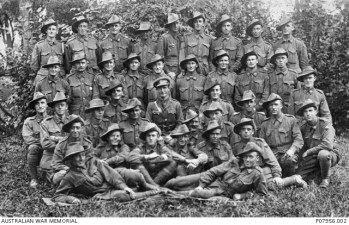 On the night of the 16th/17th September the 22nd Battalion entered the front-line in a sector on the Westhoek Ridge, taking over from the 17th & 19th London Regiments. The 6th Brigade held a double frontage, for the 5th & 7th Brigades were preparing for the attack on the 20th September. During the 48 hour short tour of the front-line valuable reconnaissance and preparatory work was undertaken, but heavy German shelling in response to the Menin Road preparatory bombardment took its toll with 33 men being killed or died of wounds, including Lieut. Greig (photographed 10 days earlier with his V Platoon) from the Gallipoli contingent.
15th Sept 1917: Menin Road artillery bombardment commences
The main bombardment ahead of the I Anzac Corps offensive at the Menin Road began.
12th Sept 1917: AIF & 22nd Bn commence move to the Ypres battlefield
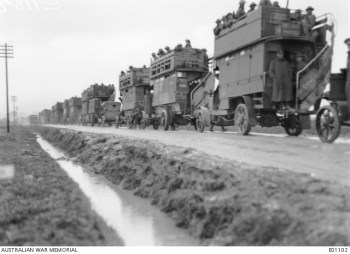 After six weeks training in the Campagne region, the 22nd Battalion along with the infantry of I Anzac Corps began to move forward in preparation for their entry into the Third Ypres offensive, with the AIF 2nd Division (photograph right) to Reninghelst and the 1st Division the following day to Ouderdom. During the moonlit nights and during the day the German air force harassed the troops in their camps or on the move by bombing or machine-gun attacks. At no time within the experience of the Australian infantry were the German airmen so active behind the lines. At night searchlights would pick out their prey before the anti-aircraft batteries would try and shower them with shrapnel.
16th Aug 1917: Ypres step 2- Battle of Langemarck
 The Battle of Langemarck was the second of the general attacks in the 3rd Ypres offensive. The Allied attack succeeded from Langemarck to Drie Grachten, with the French First Army on the northern flank and the main British gain occurring near Langemarck, adjacent to the French. However early advances in the south on the Gheluvelt Plateau were forced back by powerful German counter-attacks. The Germans appreciating the tactical value of the ground concentrated their efforts in retaining the ridge through determined defence and counter-attacks. By the end of the month Inverness Copse changed hands eighteen times, and the British had suffered some 100,000 casualties for little gain in these attritional step-by-step attacks.
16th Aug 1917: No.3 ACCS Brandhoek bombed
 The Australian No.3 Casualty Clearing Station at Brandhoek (photograph right) was bombed killing an officer and one man, and five days later the Germans began to shell it. The nurses refused to leave, but eventually the hospital had to close and move to British No.10 CCS. Also on this day saw the second of the general attacks in the 3rd Ypres offensive, the Battle of Langemarck.
 Following the Twenty-Second