
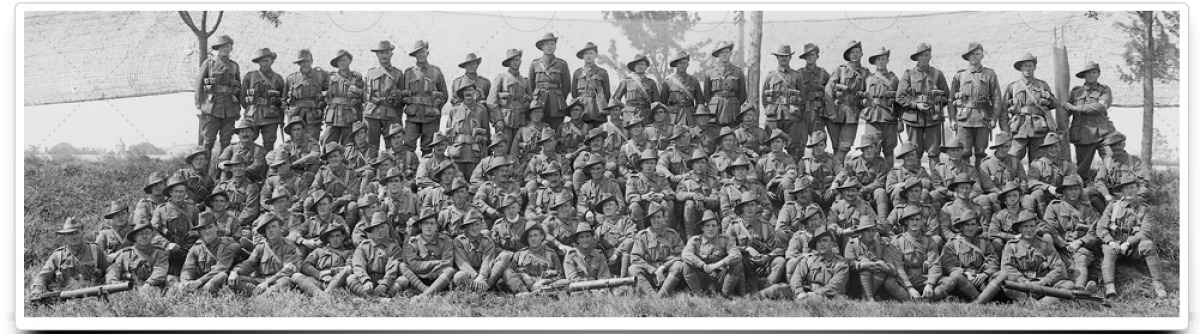
Before dawn the Germans mounted an attack on the whole front of the AIF 1st Division and the right company of the AIF 2nd Division in front of Lagnicourt. Due to the broad nature of the frontage, the Australians had to defend their isolated posts beating back the attackers by Lewis gun fire and by bombs when the attackers drew near to their positions. As with Bullecourt ammunition was becoming a major issue and messengers shot down as they attempted to make the journey back to the rear, often by German snipers that managed to encircle and then enfilade their positions. German infiltration also meant that the forward field artillery batteries were being threatened and orders were given to withdraw their breech blocks and dial sights and
retire. The guns of all four batteries of the 2nd Brigade were abandoned followed shortly by three batteries of the 1st Brigade. By 5.30am the Germans had penetrated a mile and a half behind what was the Australian forward positions at the start of the day. However with daylight the task of the defenders became easier and were able to pour relentless Lewis gun and rifle fire from the rear defensive positions into the now faltering Germans, now caught between the defensive barrage falling to their rear and the advancing Australians.
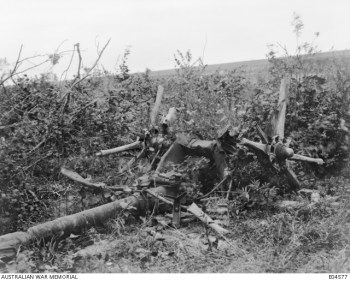 In defeating this attack the I Anzac Corps had suffered 1,010 casualties of which approximately 300 were taken prisoner. The Germans suffered 2,313 casualties, and despite having been temporarily in possession of 36 artillery pieces, 31 were back in Australian operation that afternoon (photograph showing one of the destroyed guns). The attack was a failure, particularly as the Germans threw four times the amount attackers against the thinly spread 4,000 Australians holding the line, and did not disrupt the preparations for the next Allied attack at Bullecourt. For the Allies it also demonstrated the virtues of defence in depth.
The village and the attack lay beyond the right flank of the 22nd Battalion but in range of the Lewis gunners, including L/Cpl 1187 Tourrier who estimated that his gun accounted for 40 Germans and became ‘the envy of the battalion gunners’. A party of one officer and eleven other ranks attempted a raid on one of the Battalion’s posts and were all killed, and for his work 2nd Lieut. F.Gawler received a Military Cross. Sentry 5111 Pte Winter was shot dead by the raiders, and Major JS Dooley, MC was wounded.
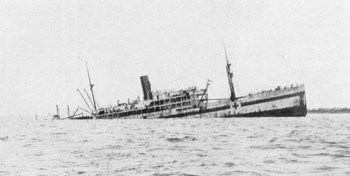
 The British Fifth Army and the right of the Third which was to take part in the great Arras offensive were separated from the Hindenburg by a chain of villages. One such village was Lagnicourt and the 26th and 27th Battalions of the 7th Brigade were tasked with attacking the village, supported by Elliott’s 15th Brigade on the right flank. The village was the first of this line to be taken but at a cost of 377 casualties. The Germans did not try to retake the village but heavily shelled the buildings and it was from a shell bursting in a sunken road that Capt. Cherry (photograph right) of the 26th Battalion, who through his good work earlier in the day had been awarded the Victoria Cross, was killed. After the capture of Lagnicourt the AIF 2nd Division was relieved by the 4th which came into the line fresh from a month’s rest and training.


 Following the Twenty-Second