
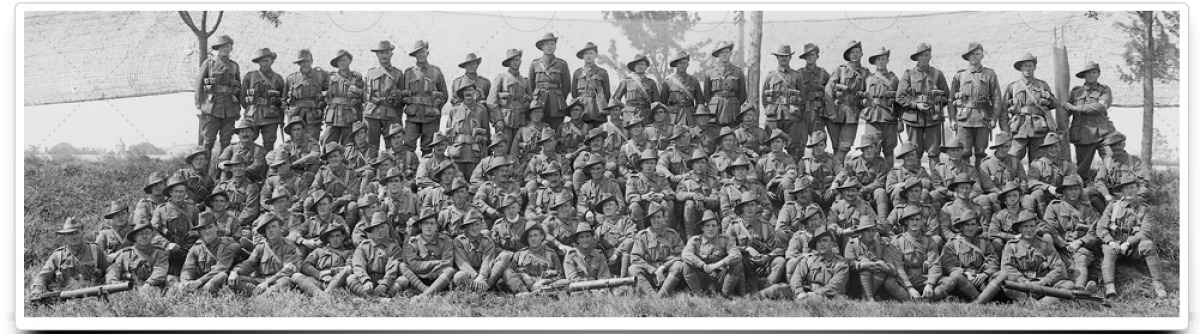
Nine officers and 195 men of the 37th & 38th Battalions raided south-west of Warneton and penetrated to the second trench capturing 33 prisoners and claimed to have killed 102 of the enemy. The raiders had 39 casualties including Lieut. Crowe and Lieut. Dixon killed in action. The raid gained General Birdwood’s congratulations.
Category: Anzacs WW1
12th Jan 1918: 22nd Bn move forward to the Catacombs dug-out ‘city’
The 22nd Battalion moved to Romarin and then via Light Railway to a system of dug-outs called the Catacombs just behind Ploegsteert Wood. These catacombs were an underground dug-out city, large enough to comfortably house a couple of 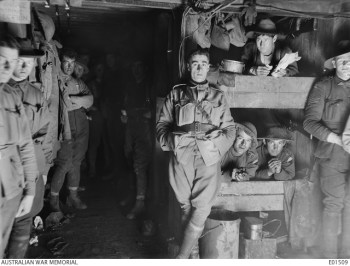 thousand men, consisting of great timbered drives and tunnels into the side of Hill 63. In galleries driven at right-angles off the main passages, long rows of wooden bunks were erected. The place was electrically lighted and though the atmosphere was a little stuffy, troops fresh from the line were very appreciative of the solid comfort of a good dry bed. [Photograph of the 6th Brigade in the Catacombs].
20th Dec 1917: Australian people reject conscription in second referendum
The Australian people rejected conscription for the second time in a referendum. Although the soldiers voted marginally in favour, the majority of the men at the front voted against, with the pro-conscription coming from the newly arrived reinforcements in the depots in England. With voluntary enlistment falling, commanders were facing the prospect of some units having to be broken up.
11th Dec 1917: Gen Allenby enters Jerusalem after Turkish surrender
Two days after the official surrender by the Turks and exactly six weeks after the fall of Beersheba, General Allenby, commander of the EEF, made his formal entry into Jerusalem. Among the mounted units to accompany Allenby into Jerusalem were the 10th Light Horse Regiment and and a representative of the New Zealand Mounted Rifles Brigade. At this time the 12th Light Horse Regiment was in the Judean Hills on the front line near Kuddis, where the disposition of the Ottoman defenders was static and quiet.
8th Dec 1917: Aus PM telegraphs London re: concerns over Trotsky’s peace proposal
In light of the recent Russian proposal for peace talks across all fronts, the Australian Prime Minister telegraphed to the Secretary of State for the Colonies: “I am seriously disturbed by the position on the Italian, Russian and Western Fronts and desire to know the views and intentions of the War Cabinet re Trotsky’s peace proposals and prospects on the Western Front and generally. I earnestly hope that His Majesty’s Government will not waver in its resolution to press on at all costs. Though recognising the appalling difficulties…. I am profoundly convinced that to recede one inch from the position taken up and set out by Lloyd George would be absolutely disastrous. Please communicate this telegram to members of the War Cabinet.” Six days later Lloyd George insisted that there could be no true peace for the Allies without reparation.
14th Nov 1917: I Anzac Corps goes into winter positions at Messines
The British Army in Flanders went into its winter positions and for I Anzac Corps, relieved from their front line positions, they proceeded to the quiet front at Messines. The Ypres fighting from September to November 1917 had cost the Australians 38,093 officers and men, and with the dwindling stream of reinforcements from Australia, anxieties were growing whether they would be able to reinforce sufficiently. For General Birdwood the focus was now turning to the winter and how to keep the troops well and avoid the illnesses and trench foot that had caused many casualties the previous winter on the Somme. Sports and entertainment were given high priority.
31st Oct 1917: Palestine – the Charge of the 4th Light Horse Brigade
After a period of stalemate in Southern Palestine from April to October 1917, on 31st October General Edmund Allenby, who replaced General Murray in June, attacked the Turkish garrison of Beersheba with some 47,500 rifles of the XX Corps and about 15,000 troopers in the Anzac and Australian Mounted Divisions (Desert Mounted Corps). Orders were issued for a general attack on Beersheba by the dismounted 1st and 3rd Light Horse Brigades and the mounted 4th Light Horse Brigade. As the leading squadrons of the 4th Light Horse Regiment of Victorians, and the New South Wales’ 12th Light Horse Regiment came within range of the Ottoman riflemen in defences directly in their track, a number of horses were hit by sustained rapid fire. While the 4th Light Horse Regiment attacking these fortifications dismounted after jumping the trenches, most of the 12th Light Horse Regiment on the left rode through a gap in the defences to gallop into Beersheba to capture the garrison. The Turkish defenders suffered many casualties and between 700 and 1,000 troops were captured, paving the way for the British capture of Gaza.
28th Oct 1917: AFA suffer many casualties in gas attacks
During a night gas attack the 5th & 6th Batteries on Anzac Ridge were put out of action. Between mid–October and mid-November there were over 1,300 casualties in the Australian Field Artillery alone, and although only a small number, 20, were quickly fatal the effects lasted for years to come. The condition of the worst cases was pitiful with eyes swollen and streaming, voices gone and bodies blistered. Whole battalions came out of the line hoarse.
22nd Oct 1917: Canadians begin relief of Anzacs at Passchendaele
The AIF 3rd Division in the II Anzac Corps Line was relieved by the Canadian 4th Division, with the Canadian 3rd Division relieving the New Zealand Division the following day.
16th Oct 1917: Germans drench Anzacs with mustard gas
For four nights between the 14th & 19th October the Germans drenched the valleys behind the Australian lines with mustard gas, causing 116 casualties in I Anzac Corps area on the 16th alone. The 43rd Battalion in II Anzac Corps had to evacuate 40 men blistered and gassed after work on the railway near Zonnebeke.
 Following the Twenty-Second