
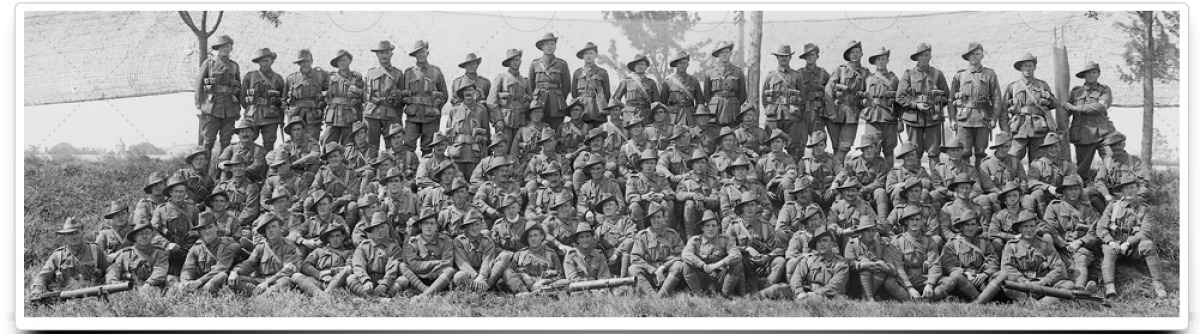
During a small memorial service held on the fourth anniversary of the beginning of the war, the commander of the British 2nd Army Sir Herbert Plumer asked Major-General Glasgow to bring some of his senior officers and then spoke to them: ”You are leaving my army. I am sorry that I cannot inform you where you are going or what you are about to do. I am sorry to lose you, but I wish you success. You know, gentlemen, that it is not my practice to make eulogistic speeches – there will be plenty of time for that after the war. At the same time I would like to tell you that there is no division, certainly in my army, perhaps the whole of the British Army, which has done more to destroy the morale of the enemy than the 1st Australian Division.”
Author: 22ndaif
3rd Aug 1918: HS Warilda sunk with loss of 123 lives
Following the conversion to a hospital ship, HS Warilda spent a few months stationed in the Mediterranean, before being put to work transporting patients across the English Channel. Between late 1916 and August 1918 she made over 180 trips from Le Havre to Southampton,carrying approximately 80,000 patients. In February 1918 HS Warilda was struck by a torpedo which fortunately failed to explode, and the following month collided with another ship the SS Petit Gaudet off the Isle of Wight, the latter being seriously damaged. However worse was to befall her when on 3rd August 1918 when transporting wounded soldiers from Le Havre to Southampton she was torpedoed by the German submarine UC-49 despite the clear display of the Red Cross markings. Damage to the engine room meant she sailed around in a circle at 15 knots, and the lifeboats could not be launched until the steam ran out. One of her escorts attempted a tow, but the line had to be cut and she sank in about two hours. That night the HS Warilda had 801 persons on board with 471 invalids, including 439 cot cases. 123 people lost their lives, including all the engine room staff, all the occupants of “I” ward (the lowest ward containing 101 “walking” patients), and 19 people from capsized lifeboats. Amongst those that died were fifteen Australians and the Deputy Chief Controller of the Queen Mary’s Army Auxiliary Corp, Mrs Violet Long (photograph left).
27th Jul 1918: 22nd Bn’s first association with the Americans
The 22nd Battalion had its first association with the Americans. ‘K’ Company of the 3rd Battalion, 129th American Regiment was attached to the 22nd Battalion for experience, with one platoon allotted to each company and one in reserve. This one full-strength American Company considerably outnumbered the entire 22nd Battalion. During the night the enemy dropped minenwerfers and ‘pineapples’ on the battalion centre and right.
24th Jul 1918: Allied Commanders agree to go on the offensive
 At a meeting at Foch’s headquarters with the Commanders-in-Chief – Haig, Petain and Pershing – the decision was made that the turning point had been reached and now time to go on the offensive across the front. The offensives must come as a surprise, and should follow as much as possible soon after the previous one to keep the enemy stretched and unable to effectively manipulate his reserves. The attack at Amiens would come first, not just because of the flat terrain that suited both the tanks and cavalry, plus being at the junction between the British and French forces enabling both to be engaged, but on no other part on the battlefield was the morale so high as that of the Australians on the Somme, and been so dominant over the enemy for four months as a result of their continuous peaceful penetration operations. However the Australians had been in the line and forward area first stopping and then harassing the Germans since April, and although not exhausted most brigades were reporting that the men were in need of a decent rest to face any major future effort. The Canadian divisions on the other hand had largely been in reserve, rested, up to full strength and being kept back for the pending offensive. It would be the two Dominion Corps that would spearhead the attack with four divisions each, supported by two divisions of the British III Corps (58th & 18th Divisions) on the left flank north of the river Somme and three divisions of the French XXXI Corps on the right flank south of the Luce.
22nd Jul 1918: 6th Bgde endures another intense gas bombardment
The Germans put over a barrage of gas-shells even more intense than that the 22nd Battalion suffered in the Aubigny system. From 10pm till early morning on the 23rd thousands of yellow-cross gas-shells fell in the ruins and the gas was blown back over the ration dumps and the Battalion Headquarters. Elaborate precautions enabled the casualties to be kept to about fifty. The other battalions in the Brigade and all units in the vicinity of Villers-Bretonneux suffered much more heavily. At this time most of the other casualties resulted from machine-gun fire, though every afternoon the left company sector was intensely bombarded. It was a stray bullet which killed Lieut. Swanton at his post.
19th Jul 1918: 2nd Div Maj-Gen Rosenthal wounded by sniper
On visiting the recently captured ‘Mound’ to the east of Villers-Bretonneux Australian 2nd Division commanding officer Maj-Gen Sir Charles Rosenthal was shot and severely wounded in the arm by a sniper and was sent back to England for treatment. This was Rosenthal’s fourth wounding of the war but he returned to duty in August in time for the Battle of Mont St. Quentin where the 2nd Division with tired and depleted forces achieved one of the finest victories of the Australians during the war.
16th Jul 1918: 22nd Bn sustain 200 casualties in large gas attack
At 11.30pm the Germans commenced a barrage of the Aubigny system and neighbouring area with gas-shells. Within three hours the enemy threw over 7,000 shells completely saturating the area with mustard-gas. The men wore their SBR for a considerable period of time and the affected area was evacuated, and shell holes filled in. In spite of the precautions taken, the intensity of the bombardment and the sultry nature of the weather causing the gas to hang about, it was apparent that the casualties were going to be numerous. At the end of 72 hours when the last of the men had been evacuated it was found that the battalion had lost 200 members including the officers commanding A & B companies. Both companies had been severely depleted that the decision was taken to amalgamate them, with Lieut. Abercrombie, MC, taking command. For his action that night in helping to minimise casualties Lieut. Anderson was Mentioned in Dispatches.
15th Jul 1918: Germans launch last offensive of the War
German commander Ludendorff launched what would be the last German offensive of the First World War against the French either side of Reims in the Second Battle of the Marne. The attack was designed as a major diversion to draw troops away from Flanders for what would be Ludendorff’s main objective, a decisive victory over the British, for defeating the Allies. The German failure to break through, or to destroy the Allied armies in the field at the Marne, allowed Ferdinand Foch, the Allied Supreme Commander, to proceed with the planned major counter offensive three days later. On the 18th July 1918 twenty-four French divisions, including the American 92nd and 93rd Infantry Divisions under French command, joined by other Allied troops, including eight large American divisions under American command and 350 tanks attacked the recently formed German salient. Victory meant that the Allies were now positioned to move on to the decisive offensive being planned for Amiens.
14th Jul 1918: Peaceful Penetration tactics remove need for ‘Hamel 2’
By peaceful penetration the Australian infantry had now secured practically all of the objectives originally set by General Monash for his developing Anglo-French ‘Hamel 2’ offensive on the Villers-Bretonneux plateau. One outstanding troublesome area was The Mound which was attempted to be taken by the 25th Battalion during a night raid which failed before the 19th Battalion completed the task the following night. Thus through peaceful penetration by two brigades of the 2nd Division new ground 1,000 yards deep on a front of 4,500 yards had been secured for a loss of 437 casualties over a two week period. For the Germans they later reported that this type of warfare cost them more than a regular attack.
Meanwhile in Flanders Peaceful Penetration by the 1st Division in the Meteren sector reached its climax on 11th July, led by Lieut. Gaskell, MC, of the 1st Battalion who within three and a half hours cleared the German front for 250 yards south of the railway taking 32 prisoners and 3 machine guns. On the north side Lieut. Morley had even more spectacular success taking 36 prisoners and four light machine guns. In the whole enterprise just one Australian had been wounded. The raids having taken place in daylight resulted in the adjacent battalions watching the streams of prisoners coming in to also join in.
7th Jul 1918: French PM congratulates victorious Australians
Many messages of congratulations were received following the Australian success at Hamel, but none more so than Monsieur George Clemenceau, the veteran statesman and Prime Minister of France, who arrived and addressed many of the men that had participated in the attack, addressing them in English “When the Australians came to France, the French people expected a great deal of you… We knew that you would fight a real fight, but we did not know that from the very beginning you would astonish the whole continent… I shall go back tomorrow and say to my countrymen, I have seen the Australians, I have looked in their faces, I know that these men will fight alongside of us again until the cause for which we are all fighting is safe for us and for our children.”.
 Following the Twenty-Second