
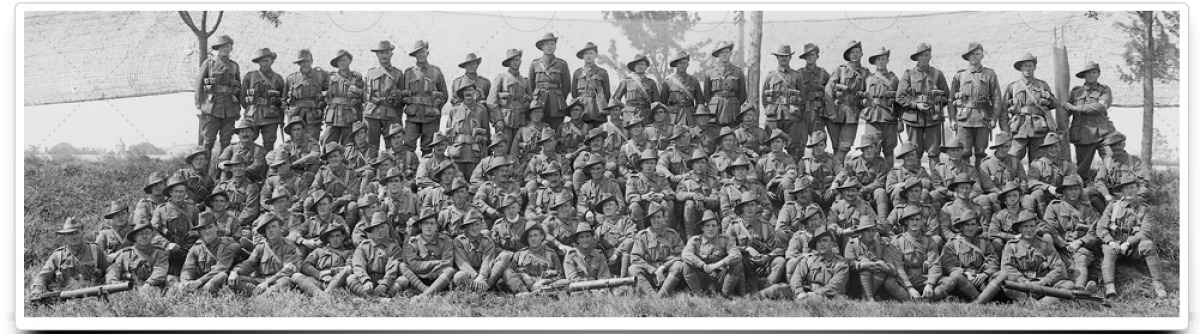
Christmas Day and Holy Communion was celebrated at 9am. During the week two large barns were placed at the disposal of the Battalion by the Marie of the village in which the companies in turn held their Christmas dinners. According to the Battalion diary ‘the dinners were all that the men could desire and went a long way to stop their complaints about the bad weather!’ For the officers twenty ‘Mademoiselles of Gourdinne’ acted as waitresses for the event.
Author: 22ndaif
24th Dec 1918: Medals awarded and married Anzac men bid farewell
 At 10am HRH The Prince of Wales presented medals to men of the 6th Brigade at Nalinnes in attendance with Lieut-Gen Sir JJ Talbot Hobbs. One Officer and 50 Other Ranks from ‘B’ Company were detailed to attend the parade and for the 22nd Battalion. Eleven men were selected to receive their medals, including RSM Cadwell, CSM Carter, and the two most decorated men from the 5th/22nd, Sgt Strachan, DCM, MM and Sgt Batton, DCM, MM + Bar. Christmas Eve also saw the start of the drafts for home, and a small party of its married original members said an emotional farewell to their old Battalion. On this and each subsequent occasion the Battalion Band played ‘Auld Lang Syne’ and the Colonel shook hands with each man and wished him ‘bon voyage’.
19th Dec 1918: 22nd Bn arrive in Gourdinne to prepare for repatriation
Leaving Barbencon at 8.30am the 22nd Battalion arrived at Gourdinne just to the south of Charleroi at 1.15pm where they found the billets to be comfortable and good. The Battalion would stay in this small Belgium town for the foreseeable future as the AIF prepared the men for repatriation and return to Australia.
1st Dec 1918: Australian Corps presented to King George V
His Majesty King George V visited the Australian Corps area. The troops of the 1st & 4th Australian Divisions lined the road entering the town of Avesnes and the troops of the 2nd and 5th Australian Divisions were drawn up in fields along the road leading from Avesnes to Landrecies. Divisional and Brigade Commanders were presented to the King at different places en route.
26th Nov 1918: Monash sends his ‘Farewell Order’ to the Corps
Lieut.-General Monash wrote his ‘Farewell Order’ to the troops of the Australian Corps thanking all the men for their splendid and loyal support of the past six months. The letter laid out the importance of the next few months, to prepare the men for their return home by re-training and acquiring the new skills required to help in the building and development of the Australian nation. Monash knew too how important it was to keep the men, desperate to get home after years away, occupied and motivated while the repatriation process ground along.
21st Nov 1918: Monash outlines AIF repatriation scheme
Lieut.-Gen. John Monash returned to Le Cateau and held what would be his last great conference of divisional and brigade commanders to launch his scheme of repatriation and industrial training for the troops preparing to return home. It was unlikely that Field Marshall Haig would release the troops under his command until February when the peace negotiations might end. It was expected that repatriation would take a year to complete so it became important that the troops understood that although the fighting had finished, they were now to be involved in the future development of Australia by acquiring the new skills and trades to take home. The priority for repatriation would be based upon i) length of service; ii) family responsibilities; and iii) assured employment. After the ‘Anzac’ contingent, the men that left in the first half of 1915 followed by those in the Australian convalescent bases in London, Monash put in place a quota system that was adopted by each division, with 1,000 men in each quota. In December and January nearly 20,000 men of the ‘Anzac’ and convalescents embarked from England. In May 1919 the last 10,000 men in France were brought to England where the camps on Salisbury Plain now held 70,000 men. At this stage Australian soldiers were marrying at 150 a week resulting in 15,000 new partners and children being carried to Australia in 1919.
20th Nov 1918: German Navy begin their surrender
 Under the terms of the Armistice German U-boats began to arrive at Harwich on the east coast of England for their surrender to the Allies. A total of 176 were eventually handed over. The following day 70 ships of the German High Seas Fleet left port and were met by the light cruiser Cardiff. They were led to the rendezvous with over 370 ships of the British Grand Fleet and other allied navies where they were escorted into the Firth of Forth in Scotland. Between the 25th and 27th November the German fleet was moved to Scapa Flow in the Orkney Islands (photograph above right).
16th Nov 1918: British commence march into Rhinelands
The British Fourth and Second Armies were detailed to commence their march into Germany where the occupation of the Rhine was an Armistice condition. The Fourth Army consisted of the 2nd Cavalry Division, VI Corps, IV Corps, IX Corps and the Australian Corps. Meanwhile the Australian Demobilisation and Repatriation Branch was formed with General White presiding.
11th Nov 1918: The Armistice is Signed Ending Hostilities at 11am
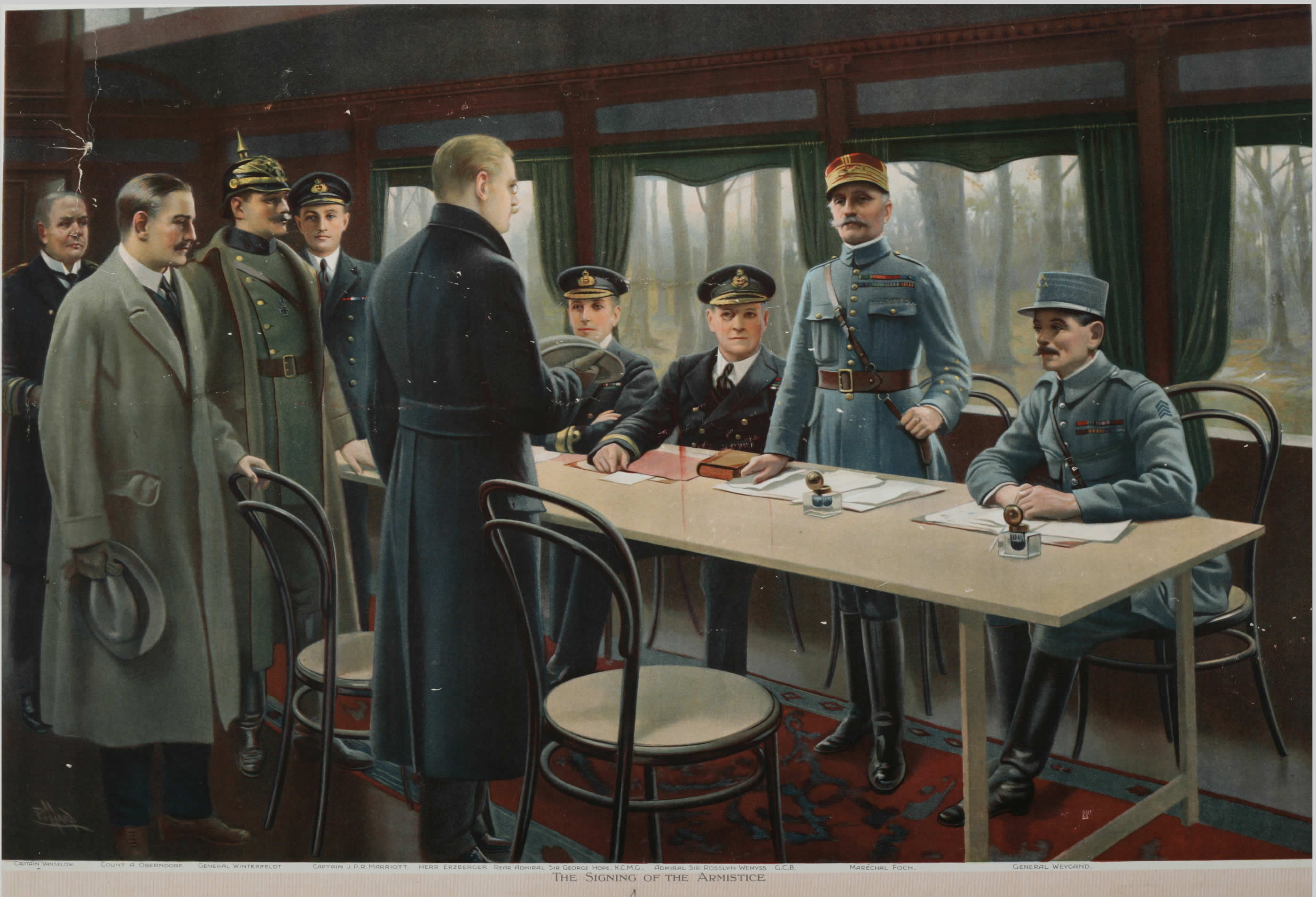 Having been given 72 hours to agree to the Allied demands amounting to a complete German demilitarisation, the German delegation headed by Matthias Erzberger agreed and at 5.20am the Armistice was signed aboard Marshal Foch’s private train parked in a railway siding in Compiegne Forest. The Armistice would come into effect at eleven am on the eleventh day of the eleventh month bringing to an end a four year war that had cost over 11 million military and 8 million civilian lives. Meanwhile in the final hours Canadian forces captured Mons in Belgium, the place where the British Expeditionary Force first engaged the German Army in August 1914.
For the 22nd Battalion the news of the Armistice was received at Battalion Headquarters at 10.30 am and a runner was sent to carry the good news to the men who were on parade. The Battalion Band marched through the village playing national anthems and the Australian and French flags were hoisted on the spire of the St. Vaast church
10th Nov 1918: Australian Divs commence return to the front
The Australian 1st and 4th Divisions began to move forward to relieve the British 32nd and 66th Divisions beyond Le Cateau. Their progress was slowed by time delayed mines that demolished railway, road junctions and bridges. Later that night Marshal Foch ordered that all operations were to cease at 11am the next day.
 Following the Twenty-Second