
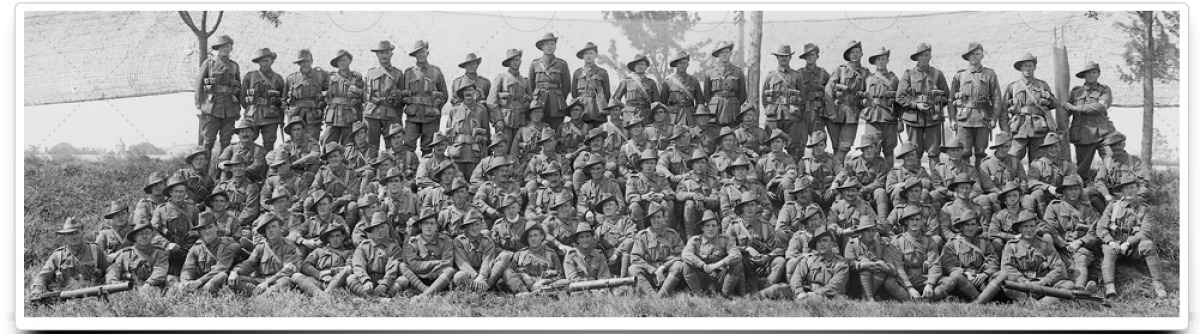
The 22nd Battalion was relieved from Bapaume and rejoined the Brigade in Mametz Wood and its huts and placed in Divisional Reserve. Bathing and training commenced.
Author: 22ndaif
26th Mar 1917: 22nd Bn moves into Bapaume & escapes Town Hall mine explosion
 Early in the morning 22nd Battalion B and C Companies moved into Bapaume and took over from 20th Battalion, and to billet in the Town Hall. However upon arrival the Town Hall (photograph right) had been destroyed the previous day by a clockwork mine, so the two companies were given the task of shovelling the Town Hall off the road and looking for survivors. A similar mine entirely destroyed the dugout system on the edge of Bapaume that was used by the 6th and 7th Brigades as their headquarters, though fortunately when the mine went off most of the 7th Brigade staff had advanced to Vaulx-Vraucourt. Orders were given that dugouts and houses left intact by the enemy must not be used by staff or troops. Meanwhile the rest of the 6th Brigade was relieved and moved into hut shelters at Mametz Wood.
26th Mar 1917: Capt. Cherry, VC, killed during attack on Lagnicourt
 The British Fifth Army and the right of the Third which was to take part in the great Arras offensive were separated from the Hindenburg by a chain of villages. One such village was Lagnicourt and the 26th and 27th Battalions of the 7th Brigade were tasked with attacking the village, supported by Elliott’s 15th Brigade on the right flank. The village was the first of this line to be taken but at a cost of 377 casualties. The Germans did not try to retake the village but heavily shelled the buildings and it was from a shell bursting in a sunken road that Capt. Cherry (photograph right) of the 26th Battalion, who through his good work earlier in the day had been awarded the Victoria Cross, was killed. After the capture of Lagnicourt the AIF 2nd Division was relieved by the 4th which came into the line fresh from a month’s rest and training.
21st Mar 1917: Downed pilot Prince Frederick of Prussia shot in front of 7th Bgde posts
 The 7th Brigade having relieved the 6th witnessed an aerial combat between four British and five German aeroplanes. A German plane came to ground in front of their posts, and several Queenslanders rushed forward shooting the pilot as he tried to run away. The pilot happened to be Prince Frederick Charles of Prussia (photograph right), and though carried to the aid post he died of his wounds in hospital a few days later.
20th Mar 1917: HS Asturias sunk with loss of 35 lives
 Not long after the resumption of the German announcement of unrestricted submarine warfare against shipping deemed to be supporting the Allied war effort, after landing 1,000 wounded at Avonmouth in the Bristol Channel, the Asturias was attacked by German submarine off the south Devon coast and struck by a torpedo which blew off her stern, killing 35 of her crew. The Captain of U20 which sank the Asturias was Capitanleutnant Walther Schweiger, who two years before had been in command of the U-Boat which sank the Lusitania. She was able to be beached near Bolt Head but her damage was so extensive that she was declared a total loss. However her hulk was put to use as a floating ammunition store at Plymouth for the rest of the war.
20th Mar 1917: 6th Bgde Gellibrand attempts to take Noreuil on own initiative and fails
6th Brigade’s Maj-Gen. Gellibrand working on his own initiative attempted to take Noreuil. The 21st and 23rd Battalions met with heavy resistance from machine guns in the surrounding villages supported by artillery. The first that Divisional HQ knew about it was when Gellibrand sent messages including falling back. To Generals Birdwood and Smythe the unexpected news of this engagement and the casualties suffered – which was eventually found to be more than twice as Gellibrand at first believed, totalling 13 Officers and 318 other ranks – came as a shock. As a result Gellibrand never regained the high opinion and confidence with General Birdwood which his vigour in previous stages of the pursuit had won.
17th Mar 1917: Bapaume entered
 AIF Brigade Commanders Gellibrand (6th) and Smith (5th – and former 22nd Battalion commander) drew up plans for a simultaneous attack on the expected German rear guard, but by the time the advance the enemy had gone. Bapaume (photograph right), the objective for the great 1916 Somme offensive, was entered. As the Allies followed the Germans in a period of cautious open warfare against the German rear-guards, bitterness grew not just amongst the French but also in world opinion against the excesses of the German military in destroying everything in its wake for little military advantage.
10th Mar 1917: 22nd Bn relieved, but within hours heads back to front
The 22nd Battalion was relieved by the 21st Battalion and marched out to Bazentin Camp. The camp was reached by 2am, but within six hours the Battalion was ordered to head back to the front and began retracing their steps of just a few hours before! Eaucourt, l’Abbaye and Le Barque were the first places to be garrisoned on reaching the advanced lines again, and daily progress was made on the heels of the retreating Germans.
8th Mar 1917: 22nd Bn relieves 23rd Bn & commences active patrolling
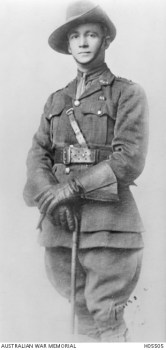 The 22nd Battalion relieved the 23rd Battalion in Malt Trench (A & C Coys), Malt Support (B Coy) and Layton Lane and outposts. Throughout his retirement the German’s policy was to man selected strong posts and hold them with machine gun crews. These crews were often scattered along a continuous trench, all protected by wire and were very difficult to locate. Patrolling was dangerous and it was in this manner that Lieut Massie (photograph right) went missing in front of the then uncaptured Grevillers line, and was later reported killed in action having been taken behind German lines.
5th Mar 1917: Bapaume burning
Heavy plumes of smoke rose from the town of Bapaume indicating that the Germans would be retreating further, while British airmen reported a greatly increased amount of train movement eastwards.
 Following the Twenty-Second