
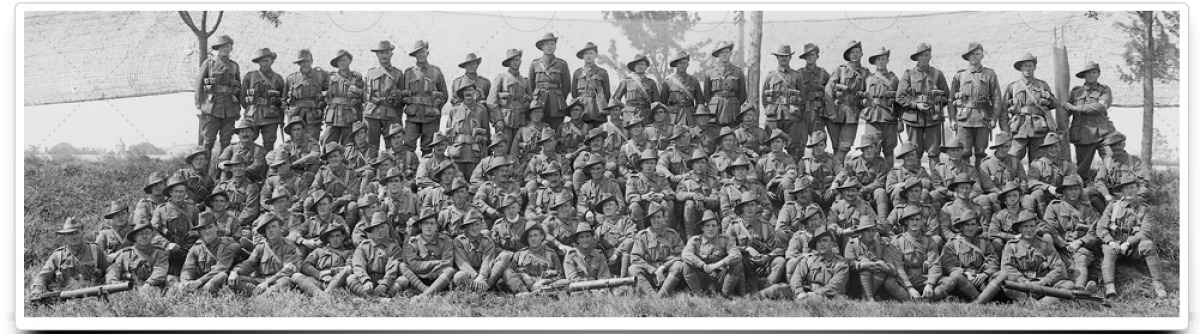
Following an agreement with the Australian Government back in February to form an AIF 6th Division, while in the Command Depots in England men started to be transferred and Taken on Strength into the newly forming battalions. From the 5th/22nd this included 2352 Pte Ponton, 2481Pte Fenwick, 2487 Pte Payne & 2419 Pte Skeggs to the 66th Battalion & 2493 L-Cpl Batton, MM, to the 67th Battalion, at the Windmill Hill training camp
Author: 22ndaif
25th Apr 1917: Anzac Day ‘holiday’
Anzac Day observed as a holiday, with battalion sports during the afternoon, and time for the men of the AIF 22nd Battalion to reflect on the 306 mates lost in the past year.
23rd Apr 1917: Bullecourt operation memo issued for 22nd Bn.

 Capt. IP Stewart, Adjutant of the 22nd Battalion, issued the operation memo for the attack at Bullecourt (with amendment 1st May) which included attack formations and would also provide the template for their rehearsals. [Click on images or see Combat Areas > 22nd Battalion > Bullecourt (Preparation) to read the memo]
19th Apr 1917: AIF 6th & 5th Bgdes relieved from front line to begin training for 2nd Bullecourt.
On the last night of the tour everyone was drenched by the heavy rain. The 5th & 6th Brigades were relieved by the 7th Brigade, with the 22nd relieved by the 25th Battalion. During this stint on the front-line the Battalion had 7 killed and 29 wounded, plus 19 sick. The Battalion went into Divisional Reserve occupying tents and bivouacs at Favreuil for training and relaxation including sports. The Divisional canteen was also stationed close-by.
17th Apr 1917: HS ‘Lanfranc’ & HS ‘Donegal’ torpedoed and sunk.

On route from Le Havre and carrying their wounded to Southampton the Hospital Ships ‘Lanfranc’ and ‘Donegal’ were torpedoed, both sinking rapidly and with the loss of 40 men on each ship. At the time the HS ‘Lanfranc’ (photograph right) had 387 patients on board including 167 wounded German soldiers, of which 18 drowned.
17th Apr 1917: 22nd C Coy dugout hit by HE shell killing three.
Enemy high explosive shell hit a dugout in the support lines containing Ptes Vass, Fry and Summersford of C Company, killing all three. L-Cpl Anderson of D Company also killed, and along with Ptes Groves and Fowles on the previous day makes this the worst 48 hour period for the Battalion since the attack at Warlencourt towards the end of February.
16th Apr 1917: Start of 2nd Battle of the Aisne.
The Second Battle of the Aisne began as part of the ‘Nivelle Offensive’. After a week of diversionary attacks by the British to the north at Arras, 19 Divisions of the French Fifth and Sixth Armies went into battle along an 80 km front from Soissons to Reims. Losses were horrendous and by the end the French had suffered 187,000 casualties, triggering mutinies within the French Army and the replacing of Nivelle by General Petain.
15th Apr 1917: Germans mount failed attack at Lagnicourt; 22nd Bn Lewis Gunners support defenders.
Before dawn the Germans mounted an attack on the whole front of the AIF 1st Division and the right company of the AIF 2nd Division in front of Lagnicourt. Due to the broad nature of the frontage, the Australians had to defend their isolated posts beating back the attackers by Lewis gun fire and by bombs when the attackers drew near to their positions. As with Bullecourt ammunition was becoming a major issue and messengers shot down as they attempted to make the journey back to the rear, often by German snipers that managed to encircle and then enfilade their positions. German infiltration also meant that the forward field artillery batteries were being threatened and orders were given to withdraw their breech blocks and dial sights and
retire. The guns of all four batteries of the 2nd Brigade were abandoned followed shortly by three batteries of the 1st Brigade. By 5.30am the Germans had penetrated a mile and a half behind what was the Australian forward positions at the start of the day. However with daylight the task of the defenders became easier and were able to pour relentless Lewis gun and rifle fire from the rear defensive positions into the now faltering Germans, now caught between the defensive barrage falling to their rear and the advancing Australians.
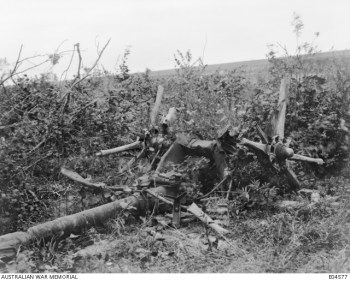 In defeating this attack the I Anzac Corps had suffered 1,010 casualties of which approximately 300 were taken prisoner. The Germans suffered 2,313 casualties, and despite having been temporarily in possession of 36 artillery pieces, 31 were back in Australian operation that afternoon (photograph showing one of the destroyed guns). The attack was a failure, particularly as the Germans threw four times the amount attackers against the thinly spread 4,000 Australians holding the line, and did not disrupt the preparations for the next Allied attack at Bullecourt. For the Allies it also demonstrated the virtues of defence in depth.
The village and the attack lay beyond the right flank of the 22nd Battalion but in range of the Lewis gunners, including L/Cpl 1187 Tourrier who estimated that his gun accounted for 40 Germans and became ‘the envy of the battalion gunners’. A party of one officer and eleven other ranks attempted a raid on one of the Battalion’s posts and were all killed, and for his work 2nd Lieut. F.Gawler received a Military Cross. Sentry 5111 Pte Winter was shot dead by the raiders, and Major JS Dooley, MC was wounded.
14th Apr 1917: 22nd Bn takes over front line near Noreuil.
The 22nd Battalion took over the front line from the 18th Battalion on the left of Noreuil, with the 5th Brigade on the right flank and British 168th Brigade on left.
13th Apr 1917: AIF 4th Div relieved at Bullecourt.
During the night the battered AIF 4th Division was relieved by the 2nd Division now concentrated in the Noreuil sector. At the same time the AIF 1stDivision farther east completed its approach further forward to within 1,000 yards of the Hindenburg Line, now responsible for a large 13,000 yards of frontage.
 Following the Twenty-Second