
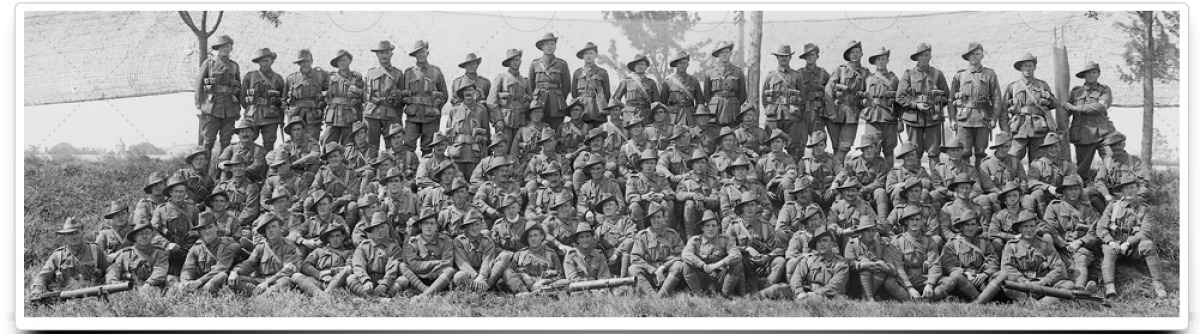
The AIF 2nd Division relieved the AIF 5th Division, with the 6th Brigade relieving 14th Brigade. The 22nd Battalion having spent a month of resting and refitting at Bouzincourt entrained at Varennes for Bapaume, and then marched to Beaulencourt where it formed part of the Divisional Reserve for the I Anzac Corps in the front area.
Author: 22ndaif
13th Jun 1917: Heavy bombers attack London
 Germany launched the first major heavy bomber raid over London with bombs dropped from 18 Gotha G.IV aircraft (photograph right). The attack killed 162 people and injured 432, the most during a single raid during the First World War. As a result of the raid London had a complete overhaul of its air defences including the introduction of public air raid warnings, air raid shelters and barrage balloons.
10th Jun 1917: Maj. Wiltshire promoted and took command of 22nd Bn
Major ARL Wiltshire was promoted to Lieut-Colonel and assumed command of the 22nd Battalion, a position he held for the rest of the war. Major Matthews returned to the Battalion and became second in command.
7th Jun 1917: Huge mines signal start of Battle of Messines
 At 3.10am the big guns began to fire and at that moment the first of the great mines exploded. Within the following few seconds the Messines – Wytschaete Ridge erupted from right to left as one after another 19 huge mines were detonated, causing an explosion so loud that it could be heard in London. The mines blew vast craters as much as 300 feet in width and 50 -70 feet deep and the devastation caused by the mine explosions plus the tremendous barrage enabled the assaulting companies advancing under the dust cloud to make easiest gains yet experienced by the Australians in the war. General Godley’s II Anzac Corps would be on the right of the offensive in the vicinity of the villages of Wytschaete and Messines and consisted of the British 25th Division on the left, the New Zealanders in the middle (in front of Messines village), and the AIF 3rd Division on the right slope of the ridge and what would be the right flank of the whole operation. The AIF 4th Division would also be called into action in the second wave pushing through to the second objective, the Oosttaverne Line. This was the first time that the Australians had encountered these ‘pillboxes’ en-masse, a form of defence structure favoured by the Germans in Flanders due to the waterlogged nature of the ground. The taking of these blockhouses often required the infantry attacking from the rear supported by rifle grenadiers keeping the defenders under cover. By sunset the final British objective had been won along practically the whole of the battle-front, and with a speed beyond any other major achievement attained by the British Army in France thus far.
6th Jun 1917: AIF 3rd Div move to attack positions at Messines under heavy gas bombardment
Shortly after 11pm the eight attack battalions of the AIF 3rd Division left their camps and billets and began their move to the front. In and around Ploegsteert Wood the infantry were coming under German artillery fire including gas, high explosive and incendiary shells. At least 500 men in the wood had been affected and put out of action, many from the effects of gas. For the others the efforts of having to proceed and carry while wearing their gas marks meant that they arrived at the jumping off line exhausted.
1st Jun 1917: Stokes Mortar accident – 20 casualties
During 6th Brigade mortar training the premature bursting of a Stokes bomb caused 20 casualties – 4 killed and 16 wounded. The accident was probably caused by a faulty shell which burst about three feet from the nozzle of the gun. Amongst those killed by the accident was 19 year-old 5058 Pte W.Mills.
26th May 1917: HS ‘Dover Castle’ torpedoed and sunk
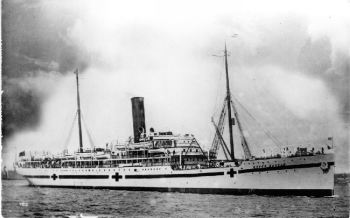 The Hospital Ship ‘Dover Castle’ was torpedoed without warning at 11 a.m. with 632 patients on board, including 29 officers. All the patients were saved, although three boats were destroyed by the first explosion. The ship was sunk by a second torpedo after being cleared.
26th May 1917: 5th Div. relieved at Bullecourt
At Bullecourt the AIF 5th Division was relieved by the British 20th Division, and I Anzac Corps by British IV Corps. Meanwhile the AIF 4th Division learns that it will be involved in the Messines attack, and unlike its sister divisions of I Anzac Corps misses the longest and most complete rest granted to the infantry of the AIF. From this time onwards the AIF 4th Division gained the reputation of the hardest worked and least rested of the Australian divisions.
20th May 1917: French Army mutinies following disastrous Aisne offensive
One of the potentially most damaging events for the Allied forces during the First World War were the French Army mutinies which started just after the disastrous Second Battle of the Aisne, the main action in the Nivelle Offensive in April 1917. General Robert Nivelle had promised a decisive war-ending victory over the Germans in 48 hours but the shock of failure soured their mood overnight. The mutinies and associated disruptions involved, to various degrees, nearly half of the French infantry divisions stationed on the western  front. The new commander General Philippe Pétain (pictured right) restored morale by talking to the men, promising no more suicidal attacks, providing rest for exhausted units, home furloughs, and moderate discipline. He held 3,400 courts martial; 554 mutineers were sentenced to death but over 90% had their sentences reprieved. The mutinies had ended by 10th June but were kept secret from the Germans and indeed the rest of the world until the danger had long past.
The French army was bending under the strain of the war that had taken its huge toll on the nation since 1914. As a result the new plan of Petain and Foch was a rigid defensive, with the exception of a few limited attacks to assist the British during their forthcoming Ypres offensive, until the Americans would be ready in 1918. Behind this defensive they would build up the army and an immense accumulation of material including artillery, tanks and the air fleet.
17th May 1917: 2nd Battle of Bullecourt ends
In the early hours the British 173rd Brigade began an operation to take Bullecourt, but on entering the remains of the village discovered that the Germans were in the process of withdrawing and captured 40 men engaged in demolishing the dugouts. The British penetrated beyond the village and occupied OG2, north of which the Germans were found to be holding a line of posts. With this action saw the end of the offensive on the right flank of the Arras campaign, one which resulted in 10,000 Australian casualties over the two Bullecourt battles.
 Following the Twenty-Second