
The build-up of American troops in Europe was progressing slower than expected. Conscription meant that men had to be trained, but the main issue was the insufficient number of transports available to ship the men across. By the end of January only four American divisions had arrived.
Author: 22ndaif
30th Jan 1918: 22nd Bn move to back area near Boulogne
After detraining at Lottinghem in the early hours and marching for six kilometres, the 22nd Battalion arrived at Selles, about 20km from Boulogne. There was no sign of a village but just widely scattered huts of differing quality. However for the Battalion this was the furthest that they had been from the front line since their arrival in France two years earlier, offering ample opportunity for leave to Boulogne, and here they remained until 6th March. The strength of the Battalion at the end of the month was 48 officers and 879 other ranks.
21st Jan 1918: 22nd Bn relieved from front line
The 22nd Battalion was relieved by the 21st Battalion and went into Romarin Camp where dry clothing, socks, fires and a hot meal were waiting for the men. For the next week working parties were supplied as per the works schedule.
18th Jan 1918: CSM Carter awarded DCM during patrol
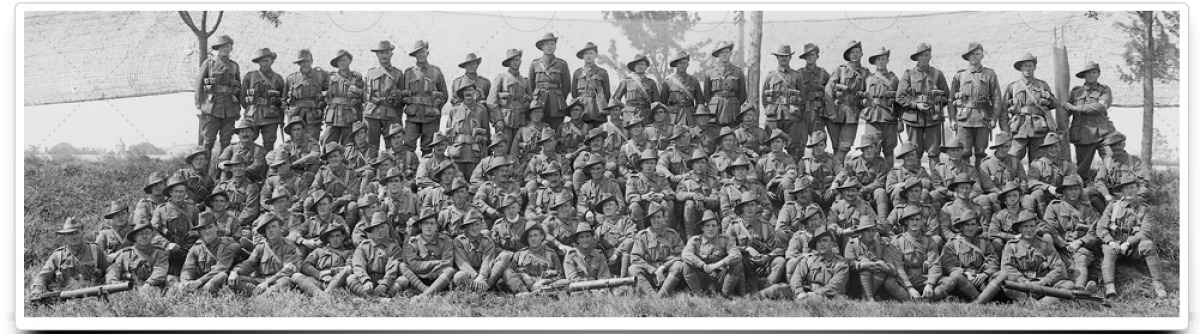
 During this period patrols were very active, frequently bringing in prisoners. Close to one of the 22nd Battalion posts a German patrol was encountered by a party under the command of 342 CSM Carter who shot the German officer and on inspection was carrying some very useful maps on trenches and troop dispositions. For this action CSM Carter [front row, third from the left, in photograph of 22nd Battalion Gallipoli Sergeants] was awarded the Distinguished Conduct Medal [click on link to read the citation].
14th Jan 1918: Air reconnaissance shows German build up opposite British
The British began to extend its front southwards taking over from the French, first to St.Quentin and then by the end of the month to Barisis. Field Marshall Haig now had 125 miles to defend with 57 divisions, but these were much weaker than before. Intelligence estimated that Germans were transferring between 30 to 40 divisions from the now quiet east over the winter, so for Haig the question was how to distribute his forces against the expected attack. With the Americans still slowly arriving it made sense that if the Germans were to attack it would be sooner than later, probably in early March. Although the weather had been bad for flying and for observation, British airmen had brought in photographs of numerous new aerodromes, dumps, railway sidings and hospital camps in the region opposite the British 3rd and 5th Armies from Arras to Peronne. But similar reports were coming in opposite the British 2nd Army on the Lys, and also on the French front in Champagne near Rheims.
13th Jan 1918: 22nd Bn take over the front line
The 22nd Battalion moved into the front line, with the 19th Battalion on the right flank and 24th Battalion on left, at La Basse Ville facing the town of Warneton, in an area with a very bad reputation owing to the number and size of ‘minnies’ employed by the Germans. The line was held by a system of posts, ‘B’ & ‘D’ Companies in the firing line, ‘A’ in support and ‘C’ in reserve. The ground was frozen hard, and snow a few inches deep lay on the ground.
12th Jan 1918: 22nd Bn move forward to the Catacombs dug-out ‘city’
The 22nd Battalion moved to Romarin and then via Light Railway to a system of dug-outs called the Catacombs just behind Ploegsteert Wood. These catacombs were an underground dug-out city, large enough to comfortably house a couple of 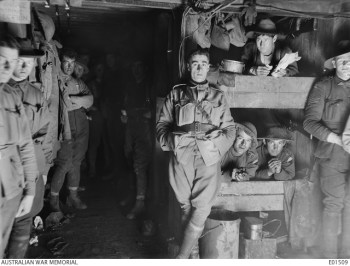 thousand men, consisting of great timbered drives and tunnels into the side of Hill 63. In galleries driven at right-angles off the main passages, long rows of wooden bunks were erected. The place was electrically lighted and though the atmosphere was a little stuffy, troops fresh from the line were very appreciative of the solid comfort of a good dry bed. [Photograph of the 6th Brigade in the Catacombs].
8th Jan 1918: Wilson publishes ’14 points’ for any peace agreement
US President Wilson published his ‘Fourteen Points’ which must be conceded by Germany before the US could think of peace. With one exception they were the same as British Prime Minister Lloyd George’s and although not all agreed by the French they became recognised as the general basis upon which the Allies would consent to negotiate.
26th Dec 1917: 22nd Bn work on Corps Line of defence at Ploegsteert
On Boxing Day the men from the 22nd Battalion continued with fatigues and the main work at the time, namely the construction of the second or Corps Defence Line, with 90 men loading and unloading stores at Romarin siding. This building of defences was in response to Field Marshall Haig’s orders that predicted that the Germans would go on the offensive in early 1918, deploying the thousands of  men and equipment now released from the Eastern Front following the Armistice with Russia, and before the Americans arrived in strength and tip the balance in favour of the Allied forces. For the men of the 22nd Battalion and 6th Brigade this meant utilising the strong natural features afforded at Hill 63 and the natural obstacle of Ploegsteert Wood, a task conducted under the supervision of Major JS Dooley, MC. [AWM photo E04488 showing men from the 22nd Battalion working on the construction behind Ploegsteert Wood]
20th Dec 1917: Australian people reject conscription in second referendum
The Australian people rejected conscription for the second time in a referendum. Although the soldiers voted marginally in favour, the majority of the men at the front voted against, with the pro-conscription coming from the newly arrived reinforcements in the depots in England. With voluntary enlistment falling, commanders were facing the prospect of some units having to be broken up.
 Following the Twenty-Second