
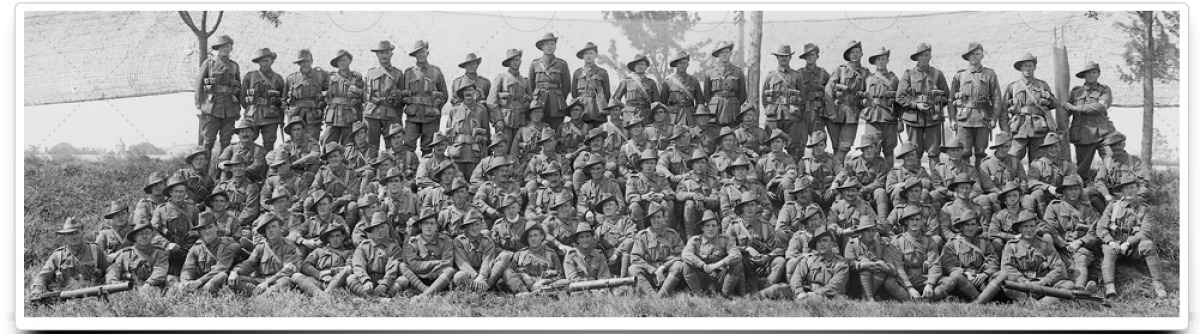
At 9pm the 22nd Battalion was relieved by the 21st Battalion who two nights later were raided by the Germans after a heavy Minnenwerfer barrage. The Battalion spent the next eight days in reserve with B, C, & D Companies at the Catacombs and A Coy plus Battalion HQ at Red Lodge, though every night spent working around the front line posts. The accommodation at the Catacombs ‘underground city’ was very comfortable and offered a good nights rest.
Author: 22ndaif
11th Mar 1918: Morale high in anticipation of German attack
With the expectation of the coming German offensive, the need to build intelligence on where the blow was most likely to fall increased. Patrols were sent out to capture and identify the opposing troops, such as by the 57th & 59th Battalions of the AIF 5th Division, but it was often the attempts by the Germans and the capture of their patrols that supplied the necessary information. Morale in the Australian Corps was high with the expectation that this time, as the defenders, they could do some serious damage to the enemy.
9th Mar 1918: Enemy shelling intensifies along the front
Enemy shelling of the country immediately behind a considerable part of the British front began to noticeably increase. In the Australian Corps sector in Flanders this shelling fell mainly in the Douve Valley and in the battery areas which were bombarded with gas. Large Gotha planes also bombed Bailleul along with German long range guns shelling the town and the dumps and villages behind the lines. This intensity included the use of ‘minnies’ on the front line trenches, and at La Basse Ville, where the 22nd Battalion were holding the front line, 2nd Lieut. Robbins of the 5th/22nd having only just returned with his commission from the Officers Cadet Battalion in England, was killed in action along with three other ranks.
8th Mar 1918: 22nd Bn returns to front line at La Basse Ville
The AIF 2nd Division relieved the AIF 3rd Division and took over the southern section of the Australian Corps front in the vicinity of Ploegsteert, with the 3rd Division retiring to the Reserve in the countryside at Nielles-lez-Blequin not far from Boulogne. With the 18th Battalion on the right flank and the 24th Battalion on the left the 22nd Battalion took up their position in the front line in front of Warneton and La Basse Ville, with the River Lys protecting the right flank. The line was held by a series of posts: two Companies occupying the front, one in support and the fourth in reserve. Patrols were active.
6th Mar 1918: 22nd Bn begin journey back to the front
After a month in the rear the 22nd Battalion began its journey back to the front line. Reveille was sounded at 2.30am and by 5am the Battalion was at Lottinghem and then entrained for Steenwerck. The night was once again spent in Kortepyp Camp. A party of 1 officer and 3 NCO’s per company proceeded to the front line for reconnaissance.
3rd Mar 1918: Treaty of Brest-Litovsk
The new Bolshevik Government of Soviet Russia agreed to peace with Germany in the Treaty of Brest-Litovsk. The harsh German terms included ceding control of the Baltic States and Poland to Germany plus the province of Kars Oblast in the South Caucasus to the Ottoman Empire, and recognised the independence of Ukraine. Historians believe that Lenin was willing to give up vast tracts of land with great economic wealth in order to concentrate on dealing with problems in the main part of Russia following the revolution and dealing with the White Russians.
26th Feb 1918: HS Glenart Castle torpedoed with 162 lives lost
 At dark on the morning of 26th February, the Glenart Castle was leaving Newport in the Bristol Channel heading towards Brest, France, when despite being lit as a hospital ship she was hit by a torpedo. The blast destroyed most of the lifeboats, while the subsequent pitch of the vessel hindered attempts to launch the remaining boats. In the eight minutes the ship took to sink, only seven lifeboats were launched, and the rough seas with inexperienced rowers swamped most of the boats. Only a few survivors were reported and 162 people were killed including the Captain Bernard Burt, eight nurses, seven Royal Army Medical Corps (RAMC) medical officers and 47 medical orderlies. Evidence later found suggested that the submarine may have shot at initial survivors of the sinking in an effort to cover up the sinking of Glenart Castle. After the war, the British Admiralty sought the captains of U-Boats who sank hospital ships, in order to charge them with war crimes. Kapitänleutnant Wilhelm Kiesewetter — the commander of UC-56 — was arrested after the war on his voyage back to Germany and interned in the Tower of London. He was released on the grounds that Britain had no right to hold a detainee during the Armistice.
25th Feb 1918: German build up continues
Air reconnaissance and other intelligence picked up signs of a new German Army HQ being established between Arras and St.Quentin. By then GHQ estimated that the German forces in the West had grown to 181 divisions, and during the following fortnight signs of a pending attack became increasingly evident.
16th Feb 1918: German divisions increasing on Western Front
British intelligence estimated that the Germans now had 178 divisions on the Western Front, with nearly half being opposite the British Army. However Field Marshall Haig felt that the main blow would come against the French to the south, but told his Army commanders to be prepared for an attack across the old Somme battlefields where communication for the British remained difficult. He also felt that the initial blow was less likely to be delivered in Flanders where the ground remained wet and therefore less suitable much later than to the south.
10th Feb 1918: Successful 10th Bgde raid congratulated by Birdwood
Nine officers and 195 men of the 37th & 38th Battalions raided south-west of Warneton and penetrated to the second trench capturing 33 prisoners and claimed to have killed 102 of the enemy. The raiders had 39 casualties including Lieut. Crowe and Lieut. Dixon killed in action. The raid gained General Birdwood’s congratulations.
 Following the Twenty-Second