
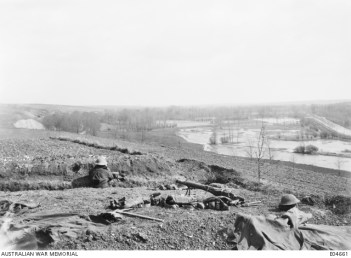
 In the south of the British line the situation on the Fifth Army’s front was becoming critical with the French continuing to withdraw in a south-westerly direction opening up a dangerous gap between the British and French armies, so Brigadier-General Rosenthal’s 9th Brigade, initially protecting the Third Army’s right flank at the River Somme (photograph right) was ordered south of the river immediately to the rear of Villers-Bretonneux and be placed under XIX Corps of the Fifth Army. To compensate for this loss and to guard the bridges Elliott’s 15th Brigade, the first of the AIF 5th Division to arrive on the Somme, were brought to Corbie and placed under Monash’s 3rd Division.
Author: 22ndaif
28th Mar 1918: German spirits drop with Dernancourt defeat by 12th Bgde
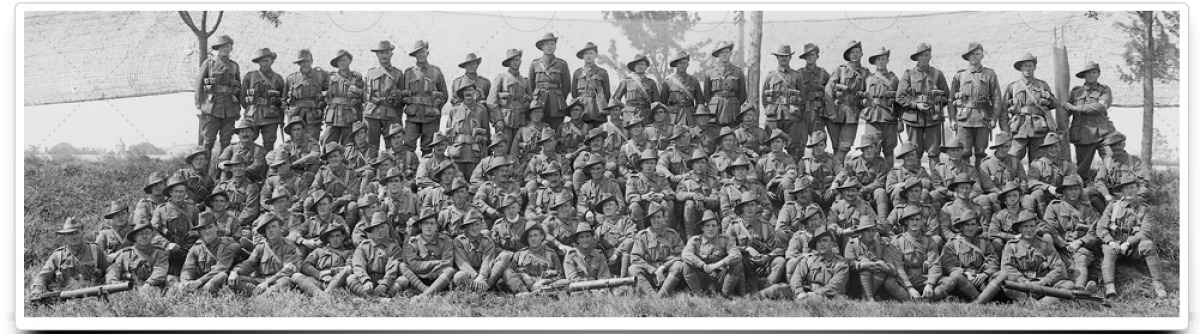
 Violent fighting took place as the Germans attempted to cross the railway line between Albert and Dernancourt held by the 12th Brigade, during which Sgt MacDougall (photograph right) of the 47th Battalion was awarded the Victoria Cross. At one stage and out of bombs the defenders could only throw stones in retaliation to the Germans on the other side throwing their grenades. Minenwerfers and shelling were also taking a toll on the exposed men firing over the rails. The 4th Division artillery supported by British batteries focused on the two German assembly points leaving the machine-gunners and riflemen to focus on the attackers that managed to get through the shell fire. By the end of the day, the spirit of the German soldier had noticeably changed from that of supreme confidence to that of being depressed having been so definitely stopped and the attempt to cross the Ancre between Albert and Buire defeated.
27th Mar 1918: ‘No retirement’ order as AIF engage German patrols
At day break the Australians of the 4th Brigade, now detached and under temporary command of the British 62nd Division, found themselves looking out over the old Somme battlefield, in many places utilising the remnants of the old 1916 support trenches along with their now rusting wire entanglements. Shortly after noon wave after wave of advancing Germans came on in a direction that would take them to the south of Hebuterne and the village of Sailly-au-Bois but the attack was broken by the 15th and 13th Battalions of the 4th Brigade pouring fire into their flank. At 4pm another column of some 150 men were seen advancing but were soon scattered by the joint efforts of the British artillery and the machine-guns of the 4th Company firing at almost a mile’s range. During the day the order came through to the 4th Brigade and all ranks that ‘no retirement’ from the present position was permissible.
To the south, by 2.30pm two battalions of the 12th Brigade lay across the eastern end of the summit of the Lavieville Down astride the Albert-Amiens Road, followed shortly by the 13th Brigade to their rear. In the confused state, troops of the 47th & 48th Battalion moving down the slope were both shelled by the Germans and attacked by British planes that had been told that any soldiers to the east of Lavieville were certain to be Germans. They took up positions along the western side of the railway. The divisional artillery had during the day reached the area of Acheux-Lealvillers-Varennes with orders to cover the front between Albert and Dernancourt.
Meanwhile arriving in convoys of London buses the 38th, 37th, 43rd & 42nd Battalions of Monash’s 10th & 11th Brigades, now the right flank of the British Third Army, took up positions between the Ancre and the Somme in the now overgrown old French trenches, without wire, taking over their occupation from small parties, remnants of British battalions that had been over-run and had retreated as the offensive rolled on. Also in the vicinity of this green, farming land devoid of mud and shell holes were patrols of British cavalry that were in contact with the enemy, which by now had taken the village of Morlancourt. As the retreating rear-guard British soldiers of mixed units melted through the AIF 3rd Division, the newest of the Australian divisions for the first time on the Somme came into contact with the German skirmishers and numerous patrols pushing forward, and were met by well-directed rifle and Lewis gun fire causing heavy losses. Towards nightfall the attempts to continue his advance died away and as events unfolded this marked the furthest that the Germans went during this part of the offensive. To their north, the AIF 4th Division had had a similar effect on halting the German advance opposite Albert and Dernancourt.
26th Mar 1918: 4th Brigade take up defensive position at Hebuterne
The stream of retreating British troops, tired and disheartened, were completely intermingled with one another and villagers. The Australians were the only ones in sight moving forward. Half eaten meals on cottage tables showed how hurriedly the people had left. The artillery of the AIF 4th Division which just three days earlier been in Flanders arrived by forced march and took up positions to cover the infantry. By nightfall orders were received to probe forward and to secure the village of Hebuterne which in turn was be probed by forward German patrols and my midnight the 13th Brigade had formed a defensive line through the village.
 However orders were received that the AIF 4th Division had to urgently march to a new destination south and towards Albert, and the 12th & 13th Brigades who had just reached their billets had to set off on a night march, accompanied by the sound of planes bombing and machine-guns rattling off to their left. Leaving the 4th Brigade at Hebuterne the column moved through almost empty villages, reaching their destination in the once familiar countryside between Warloy and Albert by dawn. The two Brigades of Gen. MacLagen’s 4th Division, plus the three of Gen. Monash’s 3rd Division would come under the command of General Congreve’s VII Corps and be tasked to deploy in a line across the German Army that had broken through his line between Albert and Bray, and now heading towards Amiens between the Ancre and the Somme. The Australians were now the most southerly of the British Third Army and given the task to protect its right flank. If the Germans were not stopped at about the line of the old French defences of 1914/15 to the east of Amiens then the German Army would be free to turn northwards behind the line of the British Third Army and southwards across the Somme and behind the Fifth Army.
25th Mar 1918: Spirits lifted by arrival of AIF 4th & 3rd Divs
 News began to come in that the German Army were now fighting in High Wood, within a short distance of Pozieres where two summers previous I Anzac Corps fought its bloodiest battle. In fact the British front was broken with the Fifth Army driven back and the serious danger of the separation of the British and French Armies. The orders coming through to the two Australian divisions preparing to move were now in a tone reflecting the seriousness of the situation and that everything must be done to halt the Germans, for many, at last, the very job for which they had enlisted and gone overseas. As the troops crammed twenty-five in each lorry moved south, they carried their Lewis and machine guns plus their ammunition as they might have to fight soon after arrival. For the divisional commanding officers, trying to locate X Corps or British Divisional HQ’s was proving problematical as everything was in a state of disarray, illustrating the problem of communication and ability to create a chain of command needed to co-ordinate the defence across the various retreating units against the German advance. As the leading brigade of the AIF 4th Division arrived at St.Pol, the previously undamaged town having been twenty-two miles behind the front-line, the veteran 4th Brigade entered a town battered by the German long-range guns. The people of the village were loading carts with their possessions to beat a hasty evacuation, but their spirits were lifted by the sight and the reputation of the arriving Australians. Although in reserve the 12th Brigade whose billeting village was closest to the front picketed all roads leading from that direction into divisional reserve. For the AIF 3rd Division detraining at Doullens they entered a chaotic and rumour filled scene with the population preparing to evacuate en-masse and the exhausted British troops appearing from the east telling tales that the German cavalry and armoured cars were on their heals. With the arrival of the first battalions of the 3rd Division defensive dispositions were placed to the east of the town, and unit commanders stopped and directed hundreds of retreating but able bodied British soldiers to halt and join their defensive positions.
23rd Mar 1918: 22nd Bn return to front line
The 22nd Battalion once again took up position in the front line posts as previously, relieving the 21st Battalion, and where the gigantic ‘minnies’ were even more active than on the previous tour causing a number of casualties. Major Dooley became Commanding Officer at La Basse Ville and Lieut. Braithwaite took over his ‘C’ Company.
22nd Mar 1918: 22nd Bn on front line fatigues shelled with gas
With the start on the previous morning of the German Spring Offensive on the Somme to the south, enemy artillery and raiding was active across the whole front. Owing to the 24th Battalion losing 150 men to gas shells the previous day the 22nd Battalion had extra work on strengthening the line, with nine officers and 250 men working at night. The men from the 22nd were too subject to these gas shells which caused a number of casualties.
22nd Mar 1918: Orders issued for 3rd Div. to prepare to move
For the AIF 3rd Division in reserve instructions were issued for all units to prepare for a move, to dump unessential baggage, to fill up all mobile supplies, and to stand by in readiness to march at a few hours notice. The first orders received said that it was to move north and Ypres – and not south and to the Somme that it had hoped – to be placed in army reserve in case of a secondary attack. However within a day the order had been changed and they began their move along with the AIF 4th Division to head south and to join the British X Corps in reserve.
21st Mar 1918: German Spring Offensive launched against British
Shortly before 5am on the 21st March 1918, the mighty German force comprising four armies of 27 divisions and supported by the biggest artillery barrage of the war with more than three million shells fired in five hours, fell upon the central Allied position between Arras and St. Quentin held by the British Third & Fifth Armies, in what was known as Operation Michael and the start of the German Spring Offensive, or ‘Kaiserschlacht’. Aided by the foggy conditions the German Stormtroopers were able to penetrate deep into the British lines. By the end of the first day, the British had lost 7,500 dead and 10,000 wounded and the Germans had broken through at several points on the front of the Fifth Army. After two days the Fifth Army was in full retreat. As they fell back, many of the isolated redoubts were left to be surrounded and overwhelmed by the following German infantry. The right wing of Third Army became separated from the retreating Fifth Army, and also retreated to avoid being outflanked.
Within days the ferocity and speed of the German Spring Offensive saw the advancing divisions achieve territory gains on the Western Front not seen since 1914 and the formation of the trench systems that ran the length of the front. News began to come in that the German Army were now fighting in High Wood, within a short distance of Pozieres where two summers previous I Anzac Corps fought its bloodiest battle. In fact the British front was broken with the Fifth Army driven back and the serious danger of the separation of the British and French Armies. The orders coming through to the Australian divisions were now in a tone reflecting the seriousness of the situation and that everything must be done to halt the Germans, and for many, at last, this was the very job for which they had enlisted and gone overseas.
19th Mar 1918: German deserters tell of pending offensive
Statements from Alsatian and Polish deserters, a captured flying officer and other prisoners were all pointing to the principal point of attack on the British sector would be between Arras-St.Quentin in the coming days. The troops of the British 3rd & 5th Armies were told to expect an attack on the morning of either 20th or 21st March. However for the men in the front, warnings had been issued before and nothing had happened. In light of the intelligence Haig transferred four of his divisions from the 2nd Army in the north to the 3rd & 5th Armies expected to take the brunt. The triple defence system had been established along the British line, but the sector recently taken over from the French was in the poorest condition. Moreover the Fifth Army’s sector was the widest and most lightly held. For the purposes of harassing the enemy, 700 cylinders containing gas were fired from the AIF 5th Division’s front by a special company of the Royal Engineers. The history of the 226th RIR says that 21 of its men were gassed, nine fatally.
 Following the Twenty-Second