
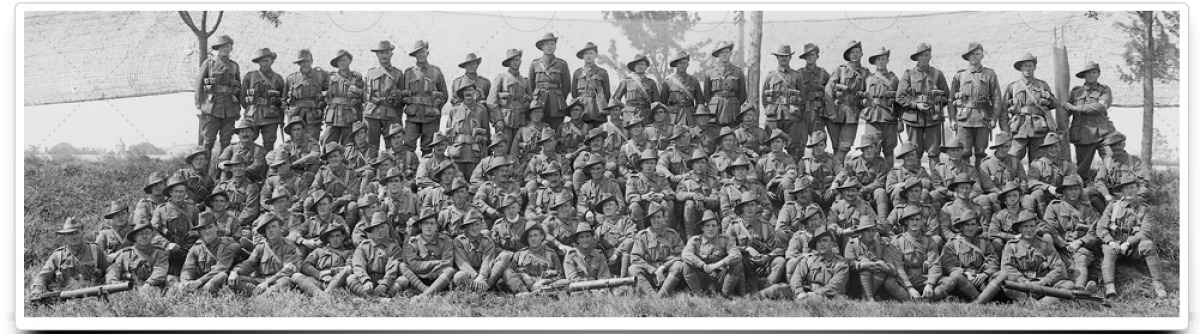
Heavy rain fell practically all day but the men with little shelter in the outpost line were more concerned by the action of enemy snipers firing from Dernancourt. The 22nd Battalion responded with Sgt Thurlow and Pte Wilson being the most deadly snipers within 6th Brigade, who totalled 57 certain hits during the April tour of the front line. On the 8th April Sgt Thurlow was awarded the Military Medal for gaining ascendancy over the enemy despite being heavily sniped at himself. Later in the day ‘A’ Company relieved ‘C’ Company in the outposts.
Author: 22ndaif
7th Apr 1918: 22nd Bn take up position opposite Dernancourt
 After a stormy night, accompanied by barrages from both sides, the Battalion had taken over very a large section of the front overlooking Dernancourt and its railway embankment (photograph right) and to the left Albert, with the Virgin Mary statue still leaning precariously. The previous day the relieved battalions of the 12th Brigade had just beaten off a major German attack. An enemy attack was expected daily, with the men in the basic outposts, and practically no trenches, enduring the poor weather as well as the shell fire and offensive patrolling. The orders were simple: “There will be no withdrawal. Every bit of ground will be fought for.” On the left of the 22nd were the 23rd Battalion, and on the right the 26th of 7th Brigade.
5th Apr 1918: Ludendorff calls off Operation Michael
With the German offensive running out of steam Ludendorff called off Operation Michael on the 5th April and his attentions now moved to the next phase of the offensive. During Operation Michael the Allies lost nearly 255,000 men, 1,300 artillery pieces and 200 tanks, but all of this could be replaced particularly with the American manpower. German troop losses were 239,000 men, many of them specialist Stormtroopers who were irreplaceable. Although achieving significant success and territory gains on the Somme in the first week of their Spring Offensive, the German Army was becoming exhausted, it’s elite units depleted, and it was becoming increasingly difficult to move supplies and artillery forward to support the advance across the wastelands of the 1916 Somme battlefields plus the destruction caused by the Germans themselves during the 1917 withdrawal to the Hindenburg Line. In terms of morale, the initial German jubilation at the successful opening of the offensive soon turned to disappointment, as it became clear that the attack had not achieved decisive results.
General Rawlinson, British Fourth Army Commander later said: “I feel that no mere words of mine can adequately express the renown that they have won for themselves, and for the position they have established for the Australian Nation, not only in France, but throughout the world”. French Prime Minister Clemenceau added: “We knew you would do well: we did not know you would astonish a Continent.”
5th Apr 1918: 22nd Bn arrive in deserted Amiens
 The 22nd Battalion detrained at 5.15am at St. Roch Station, Amiens, and marched 11kms to the village of Bertangles packed with troops, arriving there about 11am. ‘A’ Company was left temporarily behind at St. Roch to assist in the detraining process, while the other three companies enjoyed a fairly good rest in the afternoon. By the time the Battalion returned to the Somme, Albert and the villages to the east including Pozieres and Bullecourt now lay in German hands and its forces were now placing artillery fire and danger on the pivotal city of Amiens. Amiens was now deserted except for a few scattered groups of civilians passing and making for the railway station, its streets now littered with debris and tangled wire. For the men of the Twenty-Second their morale was high, exalted by the emergency and by his knowledge of the seriousness of the situation.
4th Apr 1918: Resumed German offensive on 21 mile front held
At 5.30am a German bombardment fell on all the villages in the area of Villers-Bretonneux southwards as well as the front line itself signalling an imminent attack. At 7am the whole German line was seen to advance – a resumption of the offensive across a 21 mile front now that the German engineers had laid new railway lines enabling artillery and ammunition to be brought forward – and with the S.O.S. flare fired the British barrage fell upon the advancing infantry and combined with an intense rifle fire sent them to ground. However on the 35th Battalion’s left flank the Germans had broken through the British 14th Division on the north of the Roman Road and began to appear in their rear.
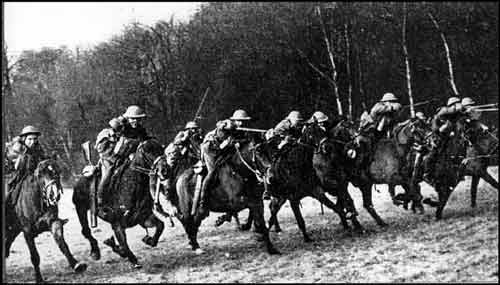 By 11.35am the troops of the AIF 3rd Division north of the Somme spotted German infantry entering the village of Hamel, but although British infantry were retreating the Cavalry in the area performed well to help secure a new defensive position to the north-east of Villers-Bretonneux up to Hill 104 which commanded observation both east over the Germans and west to Amiens. In the afternoon the Germans broke through the British to the south of the 9th Brigade. This event caused consternation at headquarters and the 36th Battalion was ordered to counter-attack. Moving at a jog-trot the 36th quickly passed the crest of the hill and came in view of the advancing Germans, who at once hesitated and turned back into the wood. Meanwhile on the Roman road the 33rd Battalion leapt at the chance of counter-attacking with the Cavalry with their swords and lances drawn, while at the same time three cars of a Canadian motor machine-gun battery lent by the IX Corps roared into action.
The German offensive of the 4th April, though it had failed in its objective, had driven back the British Fourth Army on its whole front and at some points for nearly two miles. To the south the French had too been forced back but with reinforcements arriving the danger was probably less than at Villers-Bretonneux. The defence of Villers-Bretonneux predominately by the 3rd Cavalry Division and the 9th Brigade, who lost 30 officers and 635 men during this period, had a major influence on the outcome of the spring campaign in this area. A continuous line, albeit a thin one had been re-established north as well as south of the railway. Meanwhile the 5th Brigade having just arrived from Flanders with the rest of the AIF 2nd Division was detached from its sister brigades and assigned to hold the reserve line (known as the Aubigny Line) behind the northern flank of the Fourth Army and with the 8th Brigade now also in reserve General Rawlinson was feeling happier about keeping the Germans out of Amiens.
2nd Apr 1918: 22nd Bn view Ypres battlefields for last time
 The men rested and spent the time cleaning equipment in preparation for the move to the Somme. At 4.40pm motor buses were boarded at Neuve Eglise and the 22nd Battalion moved to billets at Berthen, about nine kilometres from Bailleul. From the big hill outside Berthen (Mont Kemmel, photograph right) a last view for the men of the 22nd was obtainable of Ypres and the Flanders battlefields.
1st Apr 1918: AIF 4th Bgde ‘saviour’ of Hebuterne
 The 16th Battalion assisted by the 13th carried out a small attack and captured a length of trench taking 71 prisoners and 4 machine-guns (photograph right). The front was advanced well down the slope and now lay 250 yards beyond the village. The crisis at Hebuterne had already ended, and the front now seemed to be settling down into trench-warfare. The 4th Brigade, now under the temporary command of the British 37th Division, was seen as the ‘saviour’ of Hebuterne and as a result was kept in the line far longer than normal.
31st Mar 1918: 22nd Bn begin move to the Somme
By now word had reached the battalion that tremendous German offensive had been launched on the Somme, and that within a few days all the old battlefields that had been won at such a heavy cost were now in German hands. A move south was expected and at 10.30pm the 10th Cheshire Battalion (25th Division) that had been fighting on the Somme in the German Offensive arrived to effect the relief.
31st Mar 1918: Gas barrage placed on Germans at Warneton in front of 22nd Bn
At 1am a planned large scale gas attack using 4 inch Stokes Mortars and Livens Projectors took place, but the barrage put down was weak. However with clear skies observation was good and continuous streams of gassed Germans could be seen carried out of Warneton.
30th Mar 1918: A turning point in the War?
The New Zealand Division on the right at Hebuterne made a sharp minor attack on a 1,200 yard frontage to secure the higher ground in front of its centre and in the process captured 230 prisoners and 110 heavy and light machine-guns and the news of this came as a great tonic to the whole of the British Army during these difficult days.
To the south a German bombardment opened up south of the Somme and on the AIF 3rd Division holding the Ancre-Somme spur, accompanied by German aeroplanes swarming overhead. The Germans were spotted deploying for the attack but even despite being a distance away were met with intense fire leading to confusion in the attackers ranks. No Germans were able to get within 300 yards of the 44th Battalion’s outpost line. To their left the 40th Battalion on the hill crest were also able to pour heavy fire into the advancing Germans who were soon stopped. Several hundred men tried to take shelter on the Somme flats but the artillery was soon brought to bear upon this group. By 4pm the only visible movement in most of the enemy’s area was that of the stretcher-bearers working among the wounded. That day the 11th Brigade lost some 150 casualties, though the enemy’s was far greater. Actual German losses are difficult to verify – some Australian’s including General Monash – put the number of killed as 3,000. This is likely to be widely exaggerated but the historian of the German 8th I.R. that was involved in the attack stated the attack ‘was a miscarriage such as the division had never before suffered…. Spirit sank to zero…. Was this the end? …Was the offensive beyond our strength?’ During the night the remainder of the Australian 3rd Division’s Artillery came into the line, and with the British 35th Division relieved by the 13th Brigade of the AIF 4th Division the front between Albert and the river Somme was now held by two Australian divisions, each of two brigades with their third still under temporary deployment elsewhere on the front. At least for the present the British front line north of the Somme was fairly secure. Furthermore the preparations for the continuance of the advance were hampered by the wet and the lack of railway communications across the old Somme battlefields. After consultations regarding the sufficiency of ammunition Ludendorff ordered a postponement to the offensive for several days.
To the south of the Somme, the 33rd Battalion of the 9th Brigade was ordered to mount a counter-attack and with a cycle unit and the cavalry of the 12th Lancers moved forward passing stragglers that had been in the front moving to the rear. The attack began at 5pm through the surrounding woods in the direction of Aubercourt, with the cavalry driving the forward elements of the enemy back enabling the 33rd to get in position to mount the main attack. As the 33rd Battalion advanced, without artillery, they soon encountered the new German front line on the crest of the ridge where machine-guns were able to enfilade into the attackers. This action was only partially successful in its territorial gains and came at a cost of 200 casualties, but it did have the desired effect of giving a morale boost to the British troops that had hitherto been on the retreat and at the same time to diminish the morale of the enemy. Also that day the 35th Battalion were brought forward to man the defence line, of some 2,800 yards in length, immediately to the south and west of the vital town of Villers-Bretonneux. Although long in length, the recovery of abandoned Lewis Guns and panniers resulted in a total of 30 Lewis and Vickers machine-guns to give a formidable defensive fire-power. Being flat countryside and bereft of wire entanglements the men in the forward outposts were ordered to dig deep, and keep low and out of sight.
 Following the Twenty-Second