
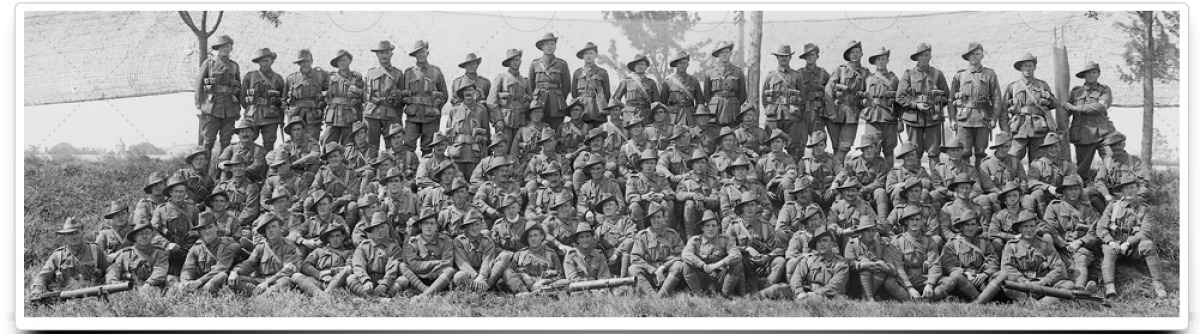
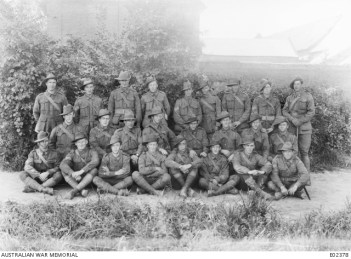
 The weather continued to be good and work remained plentiful, with digging of new trenches. It was during one of these digging parties that an accident happened. The body of a dead soldier was unearthed but the pick unfortunately penetrated the clothing containing a bomb, whereupon the pin was pulled out exploding the bomb killing Sgt Smith and wounding Lieut. Braithwaite, MC (photograph of the 22nd Battalion Gallipoli Sergeants with Sgt Smith sitting front row, far right. This photograph was taken just a week before Sgt Smith was killed). Later that day the Battalion replaced the 21st Battalion in the firing line and commenced an eight-day tour of duty.
Author: 22ndaif
6th Jun 1918: For first time all AIF Generals & Staff Officers Australian
In preparation for the next phase of the German Spring Offensive Lieutenant-General Monash held his first conference with his divisional commanders to discuss the disposition of troops and artillery in order to negate the effective enemy barrage used in the battle-zone. Major-General Hobbs pointed out that for the first time all those present, generals and staff officers, were members of the Australian Imperial Force.
31st May 1918: Lieut-Gen Monash becomes CO Australian Corps
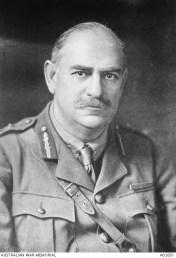 Major changes took place within the senior ranks of the Australian Corps. General Sir William Birdwood, commanding officer of the Australian Corps was given the command of the British Fifth Army, handing over the Corps to Australian born Lieutenant-General Sir John Monash (photograph right) who in turn at the AIF 3rd Division was replaced by Major-General Sir John Gellibrand, commanding officer of the 13th Brigade, and formerly of 6th Brigade. Brigadier-General Sir Neville Smyth, VC, (AIF 2nd Division) became commanding officer of the British 58th & 59th Divisions, and he was replaced by Major-General Sir Charles Rosenthal.
27th May 1918: Germans launch third major Spring Offensive on the Aisne
Operation Blucher-York, the Third Battle of the Aisne. At 1am a tremendous German bombardment fell on the whole of the Soissons-Reims front, including a crushing onslaught on the forward lines by trench mortars. The sector was partly held by five depleted British divisions – 8th, 19th (Western), 21st, 25th & 50th – which were ‘resting’ after their exertions earlier in the year. At 3.40am the Germans attacked in what was the third major campaign of the German Spring Offensive. By midday the Germans had reached the River Aisne – some five miles behind the Allied line. During the afternoon the second line between the Aisne and the Vesle Rivers was lost by both corps, and before nightfall the Germans were across the Vesle, beginning to outflank the French at Reims. The Germans in the centre had penetrated 12 miles, and by the third night as in 1914 the River Marne and then Paris (50 miles away) were becoming threatened. Petain and Clemenceau were convinced that the earlier attacks in the Spring Offensive  were merely designed to draw French reserves away to help the British in the north, and now Paris was vulnerable. Or was it just another feint to draw French resources away and for the Germans to renew their attack on the British and drive them to the sea? Foch believed it was the latter and was cautious in withdrawing his reserves in the north to the Marne.
20th May 1918: Victorious 22nd Bn relieved & march to sound of the Band
By dawn the whole position had been dug in and strongly held, and the 2nd Pioneers had dug a communication trench from the Little Caterpillar to the new front line, 200 yards beyond Big Caterpillar. So successful was the whole operation and so important to High Command that on the following day General Birdwood visited Battalion HQ in the line to convey personally his thanks and appreciation. At about 11.30pm the Battalion was relieved in the front line by the 28th Battalion and moved back to Franvillers. The Battalion Band played the victors home along the Amiens-Albert Road, and for some hours stragglers were still coming in guarding and dragging the captured trophies from the battlefield. Here in fine weather the Battalion stayed for 10 days re-organising and conducting fatigues, but as the German artillery was targeting the village the men had to dig-in in trenches on the outskirts. Most of the men were required each night for fatigue parties, while the trophies obtained during the attack dispatched back to the Australian War Museums.
19th May 1918: Sgt Ruthven wins VC at 22nd Bn Ville-sur-Ancre victory
Ville-sur-Ancre was essential to the German for the defence of Morlancourt and the battle to seize control was very much a 22nd Battalion battle, as it was the only complete unit involved in the attack. Never before had the 22nd Battalion attacked over so large a frontage (1,500 yards) with so few men, with 15 to 20 yards separating each man in the same wave on the JOT. Zero hour was set for 2am when an intense creeping barrage fell on the German line. The attackers followed so closely upon the barrage that they effectively surprised and captured the occupants of the enemy outpost line who were not able to put up much resistance. However in the ‘Big Caterpillar’ sunken lane the resistance was serious and heavy hand to hand fighting took place. By the time the sunken road had been reached the attackers had suffered heavy casualties. In front the defenders were numerous and capable of a strenuous resistance, plus the men were being sniped at from the rear. Sgt Ruthven seeing Capt. Hunter his company commander severely wounded and the seriousness of the situation took control as follows:
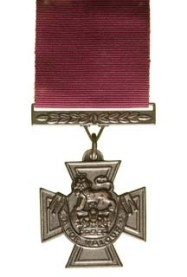 “As the leading wave approached its objective it was subjected to heavy fire from an enemy machine-gun at close range. Without hesitation he at once sprang out, threw a bomb which landed beside the post, and rushed the position, bayoneting one of the crew and capturing the gun. He then encountered some of the enemy coming out of a shelter. He wounded two, captured six others in the same position, and handed them over to an escort from the leading wave, which had now reached the objective. Sgt. Ruthven then reorganised the men in his vicinity and established a post in the second objective. Observing enemy movement in a sunken road nearby, he, without hesitation and armed only with a revolver, went over the open alone and rushed the position, shooting two enemy who refused to come out of their dug-outs. He then single-handed mopped up this post and captured the whole of the garrison, amounting in all to thirty-two, and kept them until assistance arrived to escort them back to our lines. During the remainder of the day this gallant non-commissioned officer set a splendid example of leadership, moving up and down his position under fire, supervising consolidation and encouraging his men. Throughout the whole operation he showed the most magnificent courage and determination, inspiring everyone by his fine fighting spirit, his remarkable courage, and his dashing action.”
 For this action William ‘Rusty’ Ruthven (photograph right) was awarded the Victoria Cross (citation above), the first to be awarded to any member of the 6th Brigade, and he would remain the only recipient for the 22nd Battalion during the war.
The entire operation was a success. Over 200 prisoners were captured by the 22nd Battalion alone during the battle, plus many machine-guns which ended up back in Australia at the AWM museum. However casualties amongst the Battalion’s 523 officers and other ranks that took part in the attack were heavy with 30 men killed or missing in action including 2nd Lieut. Bowden, and of the 165 men wounded Major Dooley, MC, Capt. Hunter, Lieut. Southwell and Lieut. Bourke were all incapacitated from further service in France.
18th May 1918: Audacious midday raid by 18th Bn Lieut. Irvine on 22nd Bn flank
A German machine gun strong post was proving to be troublesome on the flank between the 18th and 22nd Battalions. Intelligence officer Lieut. Irvine of the 18th Battalion suspecting that a night attack would be murderous came up with the plan to take the post in the middle of the day having witnessed most of his own troops garrisoning the front line posts napping during what were now hot sultry days. With 18 men Irvine first walked and then ran to the post without a shot being fired, capturing twenty-two prisoners and a light machine gun, without a casualty. Congratulations were received from above, especially from General Birdwood, with Lieut. Irvine receiving a Bar to the Military Cross.
16th May 1918: 6th Bgde receives orders for Ville-sur-Ancre attack
Orders came down to Brig-Gen. Paton to prepare for an attack at Ville-sur-Ancre by his 6th Brigade, an event that he himself been preparing since the 10th May. His proposal was for a night attack between moonset and dawn in the small hours, pushing past both sides of the village. On the previous nights the 24th and 22nd Battalions had by ‘peaceful penetration’ been pushing forward gradually, stealing new bits of land on either side of the river. The chief burden of the attack would fall upon the brigade’s right battalion, the 22nd Battalion who would have to capture in succession the two sunken roads known as the Little and Big Caterpillars which served the Germans  for their front and main line defences. To their right and higher up the spur was the 18th Battalion of the 5th Brigade and advancing and protecting the left flank of the attack was the 21st Battalion. The goal would be that by 4.45am the village of Ville would be enclosed on three sides. It was believed that the village was strongly garrisoned and there was no intention of fighting in it. To assist the 24th Battalion in the attack, ready-prepared footbridges were made by the 6th Field Company for the crossing of the river (photograph right).
14th May 1918: Four raiders from 22nd Bn killed attacking German strongpoint
In the early hours a raiding party from D Company attempted to attack a German strongpoint but were caught in a hail of machine gun bullets killing four of the raiders – Sgt Smeeton, Pte Atkins, Pte Arrow, Pte Lorrigan – and wounding others. Meanwhile word was now getting around that the Battalion was to be involved in a major stunt at Ville-sur-Ancre. As a preliminary the 22nd Battalion along with the 24th Battalion were relieved by the 21st and 23rd Battalions and went into support at Ribemont where the men bathed and rested.
11th May 1918: 22nd Bn begin ‘Peaceful Penetration’ operations
The forward positions for both sides were a series of outposts and every night some portion of the AIF line was pushed forward through what became known behind the line as ‘peaceful penetration’. On the night of the 10th/11th May the posts of ‘C’ Company were pushed forward without opposition in front of Marrett Wood. The 22nd Battalion took no small part in this novel warfare and the Australian Corps for nearly four months sustained, unaided, its offensive work while the rest of the British Army re-organised.
 During the night a patrol of ten under Lieut. HHM Wall pushed out in the dark along the bottom of the spur south-west of Ville-sur-Ancre to the Little Caterpillar sunken road. On nearing the German post there, Wall dropped six of his men to cover him and crept ahead with the rest. As he lay watching at a point from which the German machine guns at the sunken road and a listening post ahead of them could be made out, one of the men in the rear party coughed and shortly afterwards a patrol came out from the German lines in that direction. As it approached, Wall ordered it to halt and then as the Germans were clearly going to fight, fired. Two Germans were hit and a third captured, and the remainder ran off, chased with bombs. Wall brought back his three prisoners of the 357th I.R., 199th Division, without loss to his party. Lieut. Wall (photographed above, middle row, third from left, with other officers from the 6th Battalion) distinguished himself greatly in patrol work for which he was awarded the Military Cross.
 Following the Twenty-Second