
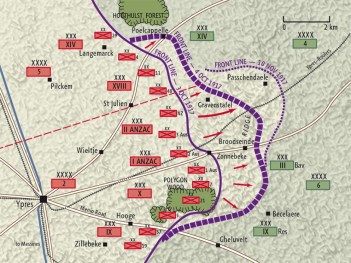
 The First Battle of Passchendaele was the last Australian attack during the Third Battle of Ypres and attempted to capture the village of Passchendaele. The AIF 3rd Division and the New Zealand Division of II Anzac Corps, with the AIF 4th Division on the flank, advanced alongside five British divisions, but were bogged down in the valley well short of their objective. For the New Zealanders this attack and day was the most costly during the entire war with 2,700 casualties. The Germans retained control of the high ground on Passchendaele Ridge opposite the I and II Anzac corps, where the attack was repulsed or troops were forced by counter-attacks to retire from most captured ground. The battle had been a German defensive success but was costly for both sides.
Category: Anzacs WW1
9th Oct 1917: Under-strength 22nd Bn attacks on flank in Battle of Poelcappelle
The French First Army and British Second and Fifth armies attacked in the Battle of Poelcappelle on 9th October 1917, on a 13,500 yards front, from the Broodseinde ridge towards Passchendaele. The AIF 2nd Division would provide the 5th & 6th Brigades for the right flank of the attack. The 5th Brigade made its second objective, but with the failure of the untried British 66th Division within General Godley’s II Anzac Corps on their left, were alone and with numbers too small to eject the Germans who remained between the posts, they themselves were beaten back to the first objective suffering heavy losses. On the right the 6th Brigade attacked with all four under-strength battalions – 23rd, 21st, 24th and 22nd Battalions from north to south – on a frontage of 1,200 yards but with an average strength of just 7 officers and 150 other ranks, and at least half of the men fresh from the nucleus at Caestre. So thin was the barrage that from the start the German machine guns were able to cause havoc for the advancing parties. During the attack the AIF 2nd Division suffered 1,253 casualties. General Birdwood later wrote that the return of heavy rain and mud sloughs was the main cause of the failure to hold captured ground. German General Kuhl concluded that the fighting strained German fighting power to the limit but that the German forces managed to prevent a breakthrough, although it was becoming much harder for them to replace losses.
8th Oct 1917: Exhausted 22nd Bn prepares for next attack
Despite being exhausted and expecting relief, orders were received to move forward and relieve the 18th Battalion. The fighting strength of the Battalion at this stage was now little more than 100, and it was necessary to bring up the men that had formed the Battalion nucleus at Caestre. Once back in the front line trenches orders for the following days attack were communicated to all concerned and final preparations made. The main thrust of the attack by nine British, Anzac and French divisions would be towards the village of Poelcappelle. The 22nd Battalion would be on the far right flank, with the junction with the 8th Battalion on their right the southerly pivot point for the whole attack.
6th Oct 1917: 6th Bgde – hundreds evacuated with exhaustion & trench feet
Having only just come out of battle, the tired and wet men, particularly of the 6th Brigade, spent hours cable laying in atrocious conditions. Having no coats they carried their waterproof sheets as capes and returned to their shell holes to find them drenched. Over the next day hundreds were evacuated with exhaustion, and many with trench feet. By the time of the attack the 6th Brigade would be down to just 600 available men, and the 7th down to 800. The 5th Brigade that had not been used in the previous attack still had 2,000 men.
5th Oct 1917: Logistics begin to break down in sea of mud
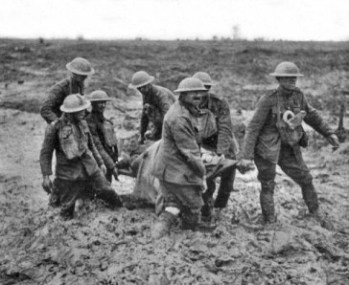 The success of the previous day had brought high expectations that further attacks could lead to a decisive breakthrough, but while Field Marshall Haig was having good fortune on the battlefield he was now losing the one thing he could not control, the weather. Rain commenced on the previous day during the attack and within a very short period of time the logistics of getting materials (artillery, ammunition, equipment) to the front, and wounded to the rear began to break down. Recently captured pillboxes were now crammed with wounded men trying to shelter from the elements and enemy shells. The rain continued as drizzle through the 5th, were constant showers on the 6th and in bitter drenching squalls on the 7th. Mules and pack-horses endlessly ploughing their way along the limited tracks quickly rendered them almost impassable. For the men of the 22nd Battalion having been relieved on the night of 5th October, the days in reserve were miserable with the regular downpours making the battle ground a quagmire. The only accommodation consisted of shell holes, half filled with mud and water, and all available men worked long hours burying cables and on fatigues.
4th Oct 1917: Broodseinde ‘Greatest victory since the Marne’
The Battle of Broodseinde was the third blow struck by the British and Australians at Ypres in fifteen days with complete success, driving the Germans from one of the most important positions on the Western Front. What made Broodseinde unusual was that both sides attacked at the same zero hour of 6am, and it was the German Army that came off worse under the intense British artillery barrage and the on-rushing British and Anzac infantry, often catching German Staff officers unawares in their blockhouses. General Plumer indeed called this ‘the greatest victory since the Marne’, and at this point the British faced the possibility of decisive success. For the Germans their Official History referred to the 4th October as a ‘black day’ as they had suffered a serious defeat and losses. However, losses for the Australians were heavy too with the three divisions sustaining 6,500 casualties plus a further 1,850 for the New Zealanders. Attacking just to the south of Zonnebeke Lake, Broodseinde was the third most costly attack in the War so far for the 22nd Battalion after Pozieres and Bullecourt, with 93 men being killed or died from wounds as a result of the battle.
3rd Oct 1917: Anzac attack battalions move forward with spirits high
The Anzac attack battalions began to move east and bivouacked in shell holes, and at various hours after dusk moved to the Jumping Off Tapes. As Bean recalls the AIF 1st and 2nd Divisions having carried out one great attack just two weeks before at the Menin Road advanced to this second operation in exuberant mood, their spirits lifted by having four Anzac divisions fighting alongside each other plus having the British 7th Division on their right whose fighting quality had been witnessed by the Australians at Bullecourt five months previous. The chief danger to the operation would appear to the chance of a break in the weather. Meanwhile for the 22nd Battalion during the day our artillery caused about 20 casualties and two Lewis guns were destroyed by shorts.
1st Oct 1917: 4 Anzac Divs in front line together for first time in WW1
For the first time in the war, four Anzac divisions were side by side in the front line, with on the right the AIF 1st Division followed by the 2nd Division of I Anzac Corps, then the 3rd Division and New Zealand Division of II Anzac Corps on the left. Further to the right (south) of the Anzacs the British X and IX Corps were positioned, and on the left (north) the XVIII and XIV Corps. In summary twelve divisions and parts of two others would attack the Broodseinde Ridge on a 14,000 yard frontage. The preliminary bombardment commenced consisting of a series of practice barrages, twice daily, but no other intense bombardment until zero hour.
30th Sept 1917: 22nd Bn receives Broodseinde battle orders
Operation: On a day to be notified, 1st Anzac, simultaneously with Corps on each flank will continue its advance. On the 2nd Division front the 6th Brigade attack on the right, 7th Brigade on the left. Before midnight prior to the attack the 22nd Battalion in support will change places with the 23rd Battalion in the line. The 22nd will carry and consolidate the Red Line. The Blue Line will be captured by the 24th Battalion on the right and the 21st Battalion on the left after passing through the 22nd. The Battalion will attack on a 4 Company frontage, each Company on a Platoon frontage. The 3rd Platoon of each Coy will be moppers up.
Artillery: At zero hour a barrage will be put down 150 yards in front of our front line. At plus 3 minutes it moves 200 yards at the rate of 100 yards every 4 minutes, thence to the Red Protective Barrage (200 yards beyond the Red Line), it moves 100 yards every 6 minutes. At plus 130 minutes it moves 100 yards every 8 minutes, finally resting on the Blue Protective Barrage (200 yards beyond the Blue Line). One smoke round per gun will be fired when the Barrage reaches each of the Protective Lines. A number of Batteries of FA, at the disposal of the Divisional Commander, can be switched on to any point holding up the attack, on particulars being furnished.
Consolidation: About 150 yards behind the Red Protective Barrage, shell holes are to be linked up. If sufficient men are not available to complete a continuous trench, sections of trench are to be dug so that a continuous line may be completed later.
26th Sept 1917: The Battle of Polygon Wood
The Battle of Polygon Wood was the second of three great successes for the AIF in the Third Ypres campaign in 15 days. The barrage which commenced at 5.50am just as the plateau became visible was the most perfect that ever protected the Australian troops. The ground was dry and each shell burst raised a wall of dust and smoke behind which the AIF 4th & 5th Divisions of I Anzac Corps together with British divisions on their flanks advanced, but this cloud created confusion for the advancing battalions and they soon became intermingled. The 15th Brigade had the hardest day where pillboxes 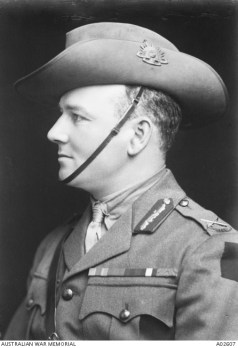 to the right of the 31st Battalion were causing problems. The 14th Brigade attacking the Butte and the 4th & 13th Brigades to their left fared better, outflanking the pillboxes, and achieving their objectives with relative ease. Protective barrages were then put in place and with the determined work by the infantry to secure their positions, successfully deterred the expected German counter-attacks. In taking its objective the 14th Brigade captured some 200 prisoners and 34 machine guns. However the success of the operation was largely down to the leadership of Brigadier-General ‘Pompey’ Elliott (photograph right) commanding officer of the 15th Brigade whose Battalions suffered that greatest of the 5,500 Australian casualties that day.
 Following the Twenty-Second