Operation: On a day to be notified, 1st Anzac, simultaneously with Corps on each flank will continue its advance. On the 2nd Division front the 6th Brigade attack on the right, 7th Brigade on the left. Before midnight prior to the attack the 22nd Battalion in support will change places with the 23rd Battalion in the line. The 22nd will carry and consolidate the Red Line. The Blue Line will be captured by the 24th Battalion on the right and the 21st Battalion on the left after passing through the 22nd. The Battalion will attack on a 4 Company frontage, each Company on a Platoon frontage. The 3rd Platoon of each Coy will be moppers up.
Artillery: At zero hour a barrage will be put down 150 yards in front of our front line. At plus 3 minutes it moves 200 yards at the rate of 100 yards every 4 minutes, thence to the Red Protective Barrage (200 yards beyond the Red Line), it moves 100 yards every 6 minutes. At plus 130 minutes it moves 100 yards every 8 minutes, finally resting on the Blue Protective Barrage (200 yards beyond the Blue Line). One smoke round per gun will be fired when the Barrage reaches each of the Protective Lines. A number of Batteries of FA, at the disposal of the Divisional Commander, can be switched on to any point holding up the attack, on particulars being furnished.
Consolidation: About 150 yards behind the Red Protective Barrage, shell holes are to be linked up. If sufficient men are not available to complete a continuous trench, sections of trench are to be dug so that a continuous line may be completed later.

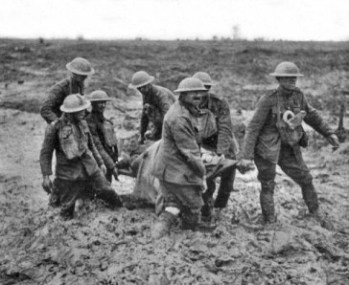 The success of the previous day had brought high expectations that further attacks could lead to a decisive breakthrough, but while Field Marshall Haig was having good fortune on the battlefield he was now losing the one thing he could not control, the weather. Rain commenced on the previous day during the attack and within a very short period of time the logistics of getting materials (artillery, ammunition, equipment) to the front, and wounded to the rear began to break down. Recently captured pillboxes were now crammed with wounded men trying to shelter from the elements and enemy shells. The rain continued as drizzle through the 5th, were constant showers on the 6th and in bitter drenching squalls on the 7th. Mules and pack-horses endlessly ploughing their way along the limited tracks quickly rendered them almost impassable. For the men of the 22nd Battalion having been relieved on the night of 5th October, the days in reserve were miserable with the regular downpours making the battle ground a quagmire. The only accommodation consisted of shell holes, half filled with mud and water, and all available men worked long hours burying cables and on fatigues.
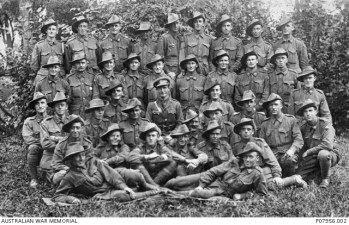 On the night of the 16th/17th September the 22nd Battalion entered the front-line in a sector on the Westhoek Ridge, taking over from the 17th & 19th London Regiments. The 6th Brigade held a double frontage, for the 5th & 7th Brigades were preparing for the attack on the 20th September. During the 48 hour short tour of the front-line valuable reconnaissance and preparatory work was undertaken, but heavy German shelling in response to the
 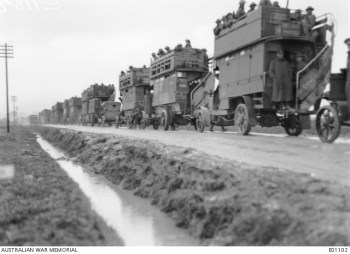 After six weeks training in the Campagne region, the 22nd Battalion along with the infantry of I Anzac Corps began to move forward in preparation for their entry into the Third Ypres offensive, with the AIF 2nd Division (photograph right) to Reninghelst and the 1st Division the following day to Ouderdom. During the moonlit nights and during the day the German air force harassed the troops in their camps or on the move by bombing or machine-gun attacks. At no time within the experience of the Australian infantry were the German airmen so active behind the lines. At night searchlights would pick out their prey before the anti-aircraft batteries would try and shower them with shrapnel.
 Following the Twenty-Second