
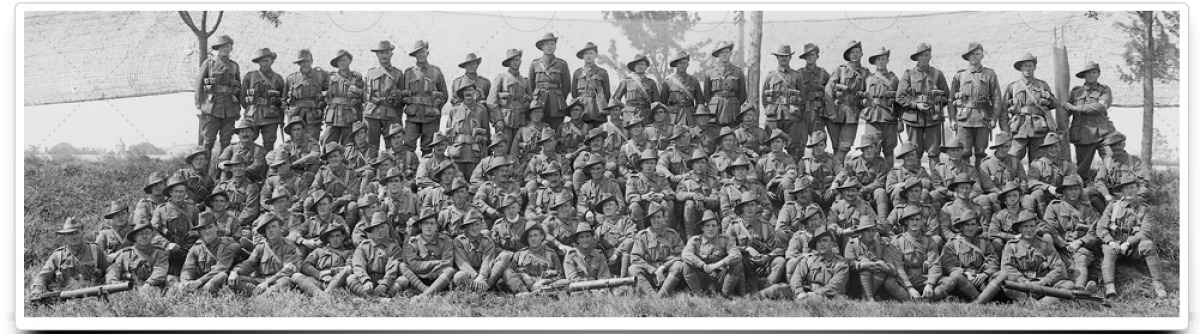
The I Anzac Corps was transferred from the British Fourth Army to the Fifth Army (formerly Reserve Army) under the command of General Sir Hubert Gough. Meanwhile back in England and following the agreement by the Australian Government to form a 6th infantry division, the creation of a new brigade, the 16th, was begun consisting mostly of men having recovered from their wounds or sickness.
Author: 22ndaif
13th Feb 1917: 22nd Bn relieved and returns to Shelter Wood Camp
Routine shelling during the day followed by enemy snipers becoming active in the evening, until they were stopped by our artillery. Later that evening the battalion was relieved by the 26th Battalion and commenced the long march back to Shelter Wood Camp. By dawn stragglers were still arriving. The following day 110 new reinforcements were received and addressed by the Battalion Commanding Officer.
11th Feb 1917: Wearing down operations on the Somme now in full swing
At midnight the 46th Battalion launched an assault covered by a shower of rifle-grenades and captured 150 yards of enemy trench. The small wearing down operations on the Somme were now in full swing, and three days later the 46th launch another attack and capture a further 25 yards.
10th Feb 1917: German bombardment kills four from 22nd Bn.
Away to the right the AIF 1st Division conducted a raid on The Maze. The 6th Brigade assisted by firing their Machine Guns and Stokes Mortars to create a diversion. The Germans responded with a bombardment in retaliation and four men from the Battalion – Ptes Kavanagh, Matson, Biber and Jago – were killed in action, making this the worst day for the 22nd Battalion since Mouquet Farm in August 1916. In addition another 10 other ranks were wounded, including L-Cpl Batton, MM, of the 5th/22nd. The weather continued to be fine but intensely cold.
9th Feb 1917: Relief of 23rd Bn in Firing Line
At 4pm the 22nd Battalion began the relief of the 23rd Battalion in the Firing Line, with a frontage of ¾ mile. In spite of considerable machine gun fire on approaches the relief was completed by 9.30pm without incident. Patrols sent out and located several enemy posts, some by presence of coughing. The enemy front line was a deep continuous trench heavily wired with listening posts in front or in the wire.
4th Feb 1917 – Capt. Murray of 13th Bn wins Victoria Cross
The 13th Battalion was tasked in attacking Stormy Trench again. In order to meet the chief danger of the German counter-attack 12,000 bombs were carried forward to the ‘jumping-off’ position, plus 1,000 rifle grenades to combat the greater range of the enemy egg bombs. The field artillery was also to double its expenditure of shells. To avoid noise during assembly the men’s feet were muffled with sandbags. As with the previous attack good progress was made and the trench easily captured along with a number of deep dug-outs. The counter attack came and desperate bombing fights ensued, followed by a swift, heavy and accurate German barrage on the supporting and bomb-carrying troops. The success of the attack was largely due to Capt. Murray’s leadership on the right for which he was awarded the Victoria Cross, though the operation had cost the Australians about 350 casualties against the German losses of 250 including 100 missing.
3rd Feb 1917 – United States severs diplomatic relations with Germany
The United States severs diplomatic relations with Germany as U-Boats threaten US shipping. Intercepted messages reveal that Germany is provoking the Mexicans into war against the US.
1st Feb 1917 – 22nd Battalion move forward to Le Sars sector
The morning was devoted to gas drill and foot rubbing. Companies fell in outside their huts in battle order wearing steel helmets and carrying two blankets fastened to their belts. Hats and puttees were dumped with the QM, and sandbags were worn as gaiters instead of the puttees. At 4pm the move was made by road to Shelter Wood Camp, replacing the 17th Battalion. The 22nd Battalion was heading to the Le Sars sector, facing the famous Butte de Warlencourt. The land was gripped in an iron frost, and the shell-pitted region was now a field of ice many feet thick, which men dug out with picks. It was so cold that moistened hair froze as it was brushed, and bread had to be thawed by the fire before it could be cut. The icy temperatures were also agonising on the feet and fingers, but the prospect of the thaw and return to the terrible mud of Flers and Ginchy was worse.
31st Jan 1917 – Germany warns neutrals of unrestricted submarine warfare
The German Government issued its warning to neutrals that from 1st February the waters around Great Britain, France and Italy were to be considered a barred zone, in which merchant vessels would be liable to be sunk without notice.
29th Jan 1917 – 22nd moves to Becourt Wood Camp near Fricourt
At the end of January the Battalion moved to Becourt Wood Camp near Fricourt via Meaulte with a fighting strength of 25 Officers and 668 other ranks. For the next two days the battalion trained specialists and raiders, together with medical inspection and foot washing.
 Following the Twenty-Second