
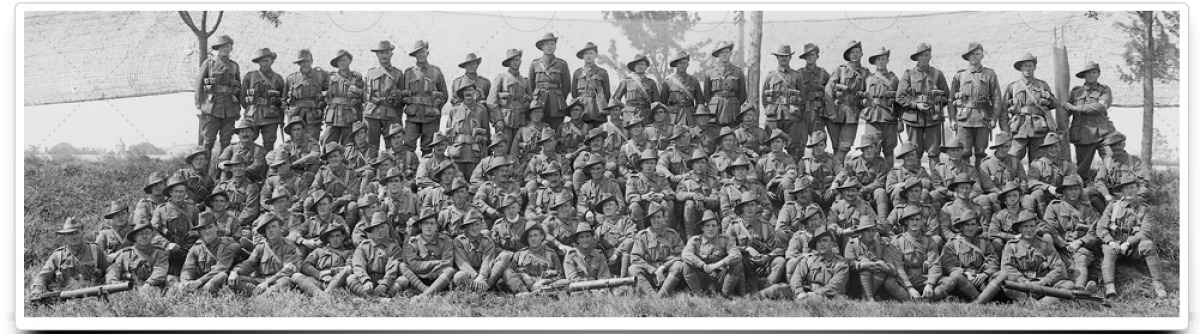
5th May 1917: 22nd Bn relieved at Bullecourt

The 22nd Battalion was relieved at Bullecourt by the 2nd Battalion and moved in small parties to the sunken road between Noreuil and Longatte. Owing to the severity of the losses, the Battalion was acting as a Company, and with each Company as a Platoon.

Meanwhile the captured position was now over 1,100 yards, with the 1st Brigade on the left and 3rd Brigade on the right, but still just connected by the one Pioneer Trench (Central Road) back to the railway embankment. By this time the trenches occupied by both sides had been largely destroyed by shell-fire. Indeed the shelling on the 5th May was of an intensity not experienced since Pozieres, with men being buried and having to be dug out with haste by their comrades.

3rd May 1917: Heroic 22nd Seizes the Hindenburg Line but at a Heavy Cost

The [Second] Battle of Bullecourt occupies a unique place in the Battalion’s annals. For no other struggle had the preparations been so complete, the rehearsals so thorough, or the general organisation so apparently perfect. Yet within a few minutes of its commencement, the combat developed into a pell-mell of violent hand-to-hand struggles, where the 6th Brigade met the flower of the German Army, and beat it into quiescence.” Capt. E.Gorman, MC, ‘With the Twenty-Second’.

The casualty rates during this battle were very high, and for the 22nd Battalion it was the worst day for fatalities in the entire war. No other battalion lost so heavily in the battle. Of the 21 officers and 618 other ranks that entered the battle, the 22nd Battalion had lost in 24 hours sixteen officers and 422 other ranks of whom over fifty percent were killed or missing – 165 killed or died of wounds according to the Commonwealth War Graves Commission records. Overall the 6th Brigade lost 58 officers and 1,422 other ranks.

Read the full accounts of the Bullecourt attack for the 22nd Battalion and the AIF 2nd Division in the Combat Areas section on this website.

2nd May 1917: Final arrangements made for Bullecourt attack

Final arrangements were completed for the attack on 3rd May, with the AIF 2nd Division and the British 62nd Division having three objectives: first the Hindenburg OG1 and OG2 Lines; second the Fontaine-Moulin Sans Souci road; and third the advance on Riencourt and Hendencourt. The 62nd, which would attack the village of Bullecourt itself, would  be supported by ten tanks in the attack while the Australians elected to attack without them. The battalions would form up on tapes 500 yards from the German line, much closer than before, and the infantry would advance under the protection of a creeping barrage. The advance would also be supported unprecedented ninety-six Vickers machine guns. Also, learning lessons from the failed AIF 4th Division attack, greater effort was made to ensure efficient ammunition and supplies went forward with the troops, and large supplies of rifle-grenades carried forward to count the longer range of the German stick and egg bombers. The weakest part of the plan, a consequence of attacking a re-entrant, was to fall on the 6th Brigade attacking to the east of the German defences in the village of Bullecourt. Brigadier-General Gellibrand’s 6th Brigade HQ moved forward to the railway embankment, practically on the front line.

30th Apr 1917: 55 merchant ships sunk in one week

30th April 1917: In the third week of April no less than 55 merchant ships – a total of 180,000 tons – had been sunk. In the month of April a total of 881,027 tons was lost. At this rate it was estimated by the end of the year that there would only be barely enough shipping to keep the British people fed, and far too few for the carriage of troops, munitions and supplies necessary to maintain the Allied war effort.

23rd Apr 1917: Bullecourt operation memo issued for 22nd Bn.

1917-04-23b.png1917-04-23a.pngCapt. IP Stewart, Adjutant of the 22nd Battalion, issued the operation memo for the attack at Bullecourt (with amendment 1st May) which included attack formations and would also provide the template for their rehearsals. [Click on images or see Combat Areas > 22nd Battalion > Bullecourt (Preparation) to read the memo]

19th Apr 1917: AIF 6th & 5th Bgdes relieved from front line to begin training for 2nd Bullecourt.

On the last night of the tour everyone was drenched by the heavy rain. The 5th & 6th Brigades were relieved by the 7th Brigade, with the 22nd relieved by the 25th Battalion. During this stint on the front-line the Battalion had 7 killed and 29 wounded, plus 19 sick. The Battalion went into Divisional Reserve occupying tents and bivouacs at Favreuil for training and relaxation including sports. The Divisional canteen was also stationed close-by.

17th Apr 1917: HS ‘Lanfranc’ & HS ‘Donegal’ torpedoed and sunk.

lanfranc-2217967_orig

On route from Le Havre and carrying their wounded to Southampton the Hospital Ships ‘Lanfranc’ and ‘Donegal’ were torpedoed, both sinking rapidly and with the loss of 40 men on each ship. At the time the HS ‘Lanfranc’ (photograph right) had 387 patients on board including 167 wounded German soldiers, of which 18 drowned.

17th Apr 1917: 22nd C Coy dugout hit by HE shell killing three.

Enemy high explosive shell hit a dugout in the support lines containing Ptes Vass, Fry and Summersford of C Company, killing all three. L-Cpl Anderson of D Company also killed, and along with Ptes Groves and Fowles on the previous day makes this the worst 48 hour period for the Battalion since the attack at Warlencourt towards the end of February.