
 The great bombardment at Ypres began, with the British guns one to every six yards of front, more than at Arras earlier in the year and almost twice as many that the 4th Army had on the Somme a year previous. For the arriving Australian artillery they would endure conditions much more severe than on the Somme, where due to German air parity and being positioned on the plains overlooked by the German spotters, the positions in the rear including the gun batteries were targeted much more heavily causing many casualties at such a rate that it was feared reinforcements would have to be raised on a scale similar to the infantry.
Category: Uncategorized
10th Jul 1917: Australian tunnelers captured and made POW
In 1917 the northern most part of the Western Front ran along the small Yser river until it entered the sea at Nieuwpoort. Previously held by the French the sector was passed over to the British 4th Army in preparation of a coastal attack (Operation Hush) to support the latter stages of the forthcoming Ypres offensive. To assist in the attack it was deemed preferable to undermine a German strongpoint and for this task the 2nd Australian Tunneling Company was chosen on account of its experience in tunneling in soft sandy conditions. Tunneling was progressing well but the Germans knowing that this was a weak point for them in the defence of the expected Ypres offensive decided to mount a limited offensive. A bombardment of the British lines caused damage to the shallow mine shafts and once the German 3rd and 10th Marine Divisions attacked at dusk, many of the Australian miners found themselves, as they dug and broke through into the open, behind the enemy. Of 50 tunnelers beyond the river only four managed to escape back to their lines, the majority being captured. In all the Germans took 1,284 prisoners and suffered themselves 700 casualties, mostly of light wounds.
2nd Jul 1917: Maj-Gen Holmes mortally wounded by shell
 While escorting Premier of New South Wales, William Holman, to survey the Messines battlefield, Major-General William Holmes, Commanding Officer of the AIF 4th Division was mortally wounded by a shell. Maj-Gen. Holmes was the most senior Australian officer to be killed on the Western Front.
29th Jun 1917: Australian French depots move to Le Havre
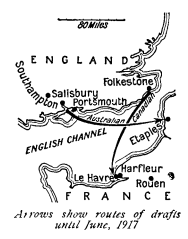 The first Australian depots in France were established in March 1916 at Etaples, but this was inconvenient both in time and increased risk of submarine attack. Etaples camp was not a pleasant place and with tough training regimes soldiers were said to be pleased to return to their units on the front! The line of transport from Southampton to Etaples crossed that of the Canadians whose English depots were near Folkestone and their French depots at Le Havre, consequently in June 1917 the depots of the two dominions changed place, with the Australians moving to the much nicer location of Harfleur outside of Le Havre (map source: Bean Official History Vol III, P.178)
28th Jun 1917: 3rd ATC destroy 3 German shafts at Hill 70, Arras
Following the earlier offensive at Arras, British High Command was becoming increasingly concerned over German tunneling activity and that charges were being placed under the British position of Hill 70. Supported by infantry of the 11th Essex and 2nd Durham Light Infantry three parties of tunnelers from the 3rd Australian Tunneling Company raided the German lines, located and successfully destroyed the three shafts. During the determined German counter-attacks Major Coulter, Commanding Officer of the 3rd ATC, and Sapper Griffin were killed, so too 2nd Lieut. FB Wearne of the 11th Essex who was posthumously awarded the Victoria Cross.
25th Jun 1917: First US troops arrive in France
 The first 14,000 U.S. infantry troops landed in France at the port of Saint Nazaire. The landing site had been kept secret because of the menace of German submarines. The “Doughboys,” as the British referred to the green American troops, were at this stage untrained, ill-equipped, and far from ready for the difficulties of fighting along the Western Front.
15th Jun 1917: 22nd Bn move into Divisional Reserve near Bapaume
The AIF 2nd Division relieved the AIF 5th Division, with the 6th Brigade relieving 14th Brigade. The 22nd Battalion having spent a month of resting and refitting at Bouzincourt entrained at Varennes for Bapaume, and then marched to Beaulencourt where it formed part of the Divisional Reserve for the I Anzac Corps in the front area.
13th Jun 1917: Heavy bombers attack London
 Germany launched the first major heavy bomber raid over London with bombs dropped from 18 Gotha G.IV aircraft (photograph right). The attack killed 162 people and injured 432, the most during a single raid during the First World War. As a result of the raid London had a complete overhaul of its air defences including the introduction of public air raid warnings, air raid shelters and barrage balloons.
10th Jun 1917: Maj. Wiltshire promoted and took command of 22nd Bn
Major ARL Wiltshire was promoted to Lieut-Colonel and assumed command of the 22nd Battalion, a position he held for the rest of the war. Major Matthews returned to the Battalion and became second in command.
6th Jun 1917: AIF 3rd Div move to attack positions at Messines under heavy gas bombardment
Shortly after 11pm the eight attack battalions of the AIF 3rd Division left their camps and billets and began their move to the front. In and around Ploegsteert Wood the infantry were coming under German artillery fire including gas, high explosive and incendiary shells. At least 500 men in the wood had been affected and put out of action, many from the effects of gas. For the others the efforts of having to proceed and carry while wearing their gas marks meant that they arrived at the jumping off line exhausted.
 Following the Twenty-Second